5×5 program: the two workouts, starting weight and limits
A 5×5 program is five sets of five reps on three barbell lifts per workout, three times a week. The two workouts, where to start, how to add weight, and when the progress stops.
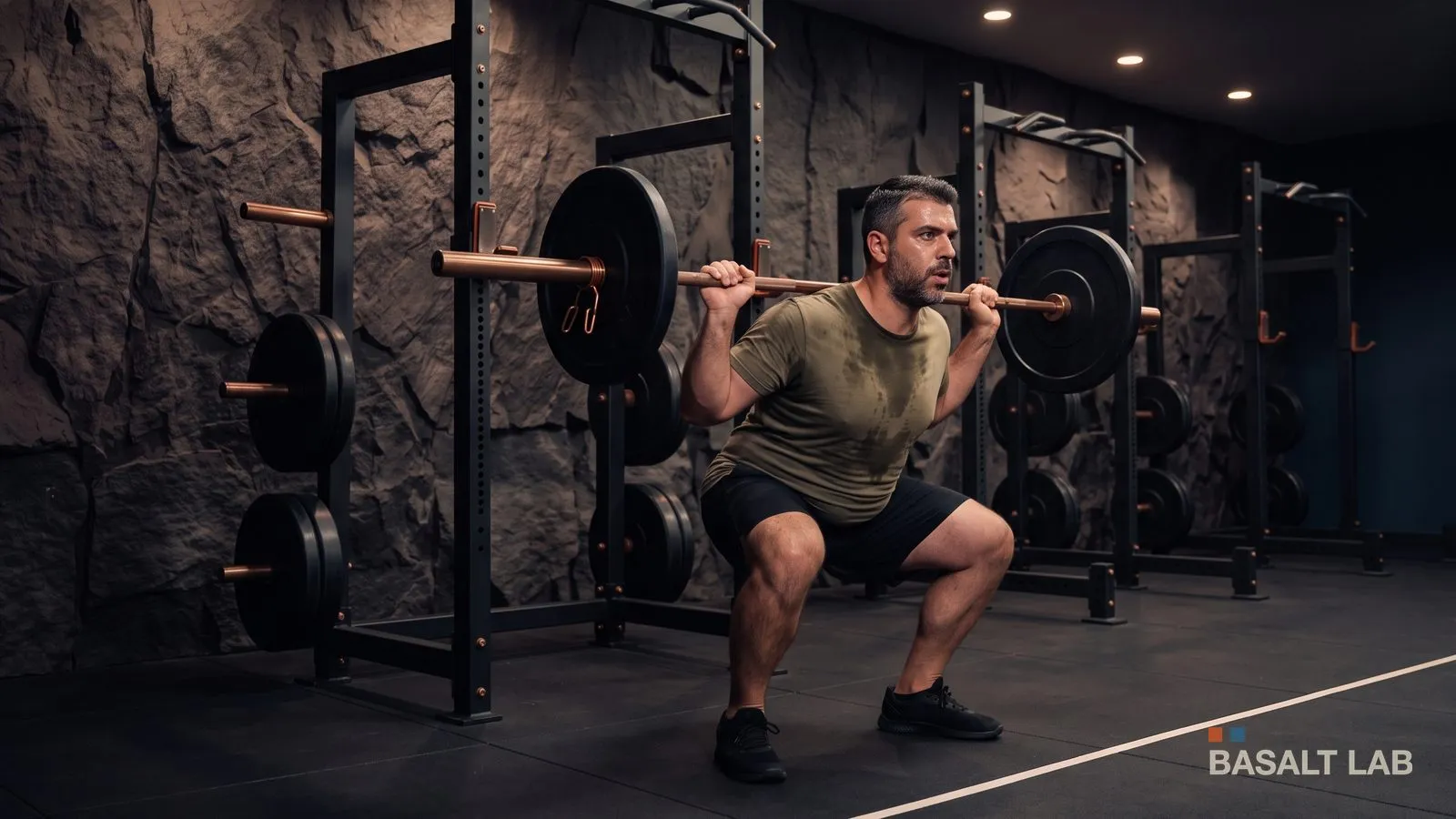
A 5×5 program is five sets of five reps on a few basic barbell lifts, with the same weight on all five sets. You alternate two workouts, A and B, three times a week, and add a little weight as soon as all 25 reps go up. It is a strength program for beginners and for lifters coming back after a break: easy to follow, and it works as long as the bar can get heavier every session.
Its strength is its simplicity: few exercises, one set scheme, one progression rule. Its limit comes from the same place. This article covers the two workouts, the starting weight, how to progress, and when it is time to move on.
The two 5×5 workouts
The whole program fits in two workouts that share five lifts. The squat comes back every session; the other lifts alternate.
| Workout | Exercise | Sets × reps |
|---|---|---|
| A | Squat | 5 × 5 |
| A | Bench press | 5 × 5 |
| A | Barbell row | 5 × 5 |
| B | Squat | 5 × 5 |
| B | Overhead press | 5 × 5 |
| B | Deadlift | 1 × 5 |
The deadlift gets a single set of five. It is hard on the back and legs, which have already squatted that day, and one heavy set is enough to keep it moving.
All five sets use the same weight, after lighter warm-up sets that do not count. Finish all 25 reps and the weight goes up next session.
The three-day week
Workouts A and B run on three non-consecutive days, with a rest day between each. Since the week has three sessions and the program has two workouts, the order flips from one week to the next.
That rhythm gives you three squat sessions a week, and the other lifts once or twice depending on the week. High frequency on a handful of movements is exactly what you need to learn a lift and load it quickly.
Starting weight and progression
A set of five taken to failure is about 86% of your one-rep max. Leave two reps in the tank and you land around 81%; leave three and you are around 79%. These numbers come from the site’s RPE chart, worked out with the Epley formula.
Start light. Pick a weight you can lift five times with at least three reps left in the tank, or lighter. The first weeks feel easy, and that is the point: they are what gives the progression room to run.
Add the smallest jump. If all five sets of five go up, add 2.5 kg next session, and up to 5 kg on the deadlift while it moves well. The plate calculator tells you what to load. If a set falls one rep short, keep the same weight and try again next time. It is the rule from when to add weight, in its simplest form.
Added every session, this progression moves fast. Here is what it does to a squat that starts at 60 kg, adding 2.5 kg three times a week without ever missing a session.
Adding 87.5 kg to a squat in three months happens to almost nobody. The math shows what the 5×5 really is: the progression works beautifully at first, then it stops, and the only question is when.
How much volume you get
The 5×5 gives the legs a lot of work and the upper body fairly little. The squat adds up to 15 sets a week, right in the useful range of 10 to 20 sets per muscle per week.
The upper body math is less generous. Bench press and rows come up twice one week and once the next: 10 sets, then 5, so 7.5 a week on average. The overhead press does the same. Chest and back stay below the range, unless you count the work the other lifts give them along the way.
That fits what the program is for. Meta-analyses find that heavy loads build more one-rep strength than light loads, while muscle growth is similar across loads when sets are taken close enough to failure. The 5×5 is built for strength; for muscle, weekly volume matters first.
When the 5×5 stops working
The 5×5 stops when you can no longer add weight from one session to the next. The sign is clear: you miss reps at the same weight three sessions in a row, on more than one lift.
At that point, two simple fixes can stretch the program. The first: drop the weight by about 10% and build back up, which often takes you past the old best. The second: switch to three sets of five on the lift that is stuck. If nothing moves, the article on the strength plateau helps find the cause, and a deload week often resets things.
When those fixes run out, you have taken what the 5×5 had to give. You need a program that progresses week to week instead of session to session, with more variety and more volume, such as an upper/lower split or push pull legs. How to choose is covered in full body vs split.
5×5 or a beginner full body program
The 5×5 is a full body program: every workout trains the whole body. It is the most stripped-down version, built around strength. The site’s beginner full body program adds exercises and higher-rep sets, which gives the upper body more volume.
Pick the 5×5 if your first goal is to lift heavier on the big lifts and you like short, repetitive workouts. Pick a more varied full body program if you mainly want to build muscle everywhere. Either way, what drives progress is progressive overload.
Frequently asked questions
Does 5×5 build muscle?
Yes, especially early on, when the weight goes up every session. But upper body volume stays low, around seven sets a week for chest and back. If building muscle is your main goal, add one or two isolation sets for the upper body, or move to a higher-volume program after a few months.
How long should you rest between 5×5 sets?
Three to five minutes on heavy sets, more for the squat once the weight gets serious. Resting too little makes you miss reps you would have made. The details are in the article on rest between sets.
How long can you run a 5×5 program?
As long as the weight keeps going up. For a beginner that is often a few months, but treat it as a ballpark: it depends on the starting weight, sleep and food. The useful signal is not the calendar but missed sessions at the same weight.
Can you add exercises to a 5×5?
One or two short exercises at the end of a workout are fine: pull-ups, core work, an arm exercise. Beyond that, sessions get long and recovery suffers, while the whole program depends on being able to add weight next time.
Is 5×5 good for women?
Yes, in exactly the same way. The structure, the starting weight and the progression do not change. The jumps can be smaller on upper body lifts, 1 kg or 1.25 kg on the overhead press, if the gym has small plates.
Five sets of five, three times a week, and 2.5 kg more when everything goes up: the 5×5 asks for nothing else, until the day the weight stops moving.
Sources
- Strength and Hypertrophy Adaptations Between Low- vs. High-Load Resistance Training: A Systematic Review and Meta-analysis, Schoenfeld, Grgic, Ogborn and Krieger, Journal of Strength and Conditioning Research, 2017.
- Resistance Training Load Effects on Muscle Hypertrophy and Strength Gain: Systematic Review and Network Meta-analysis, Lopez et al., Medicine & Science in Sports & Exercise, 2021.
- Dose-response relationship between weekly resistance training volume and increases in muscle mass: A systematic review and meta-analysis, Schoenfeld, Ogborn and Krieger, Journal of Sports Sciences, 2017.