Squat form: depth, setup and breathing
How deep to go, where to put your feet and the bar, what to do with your knees and how to breathe: squat form in a few adjustments, the common mistakes, and how to keep progressing.
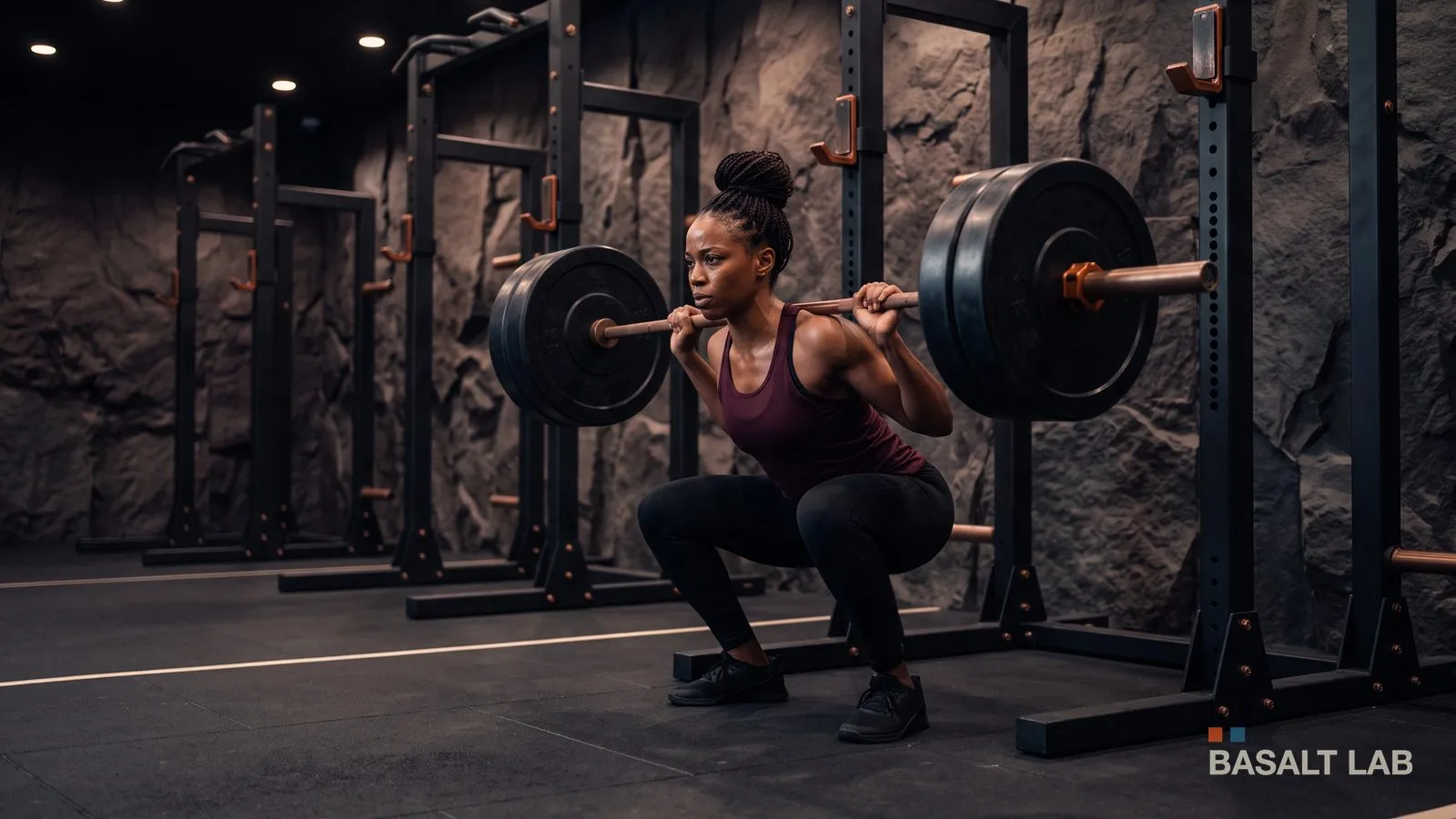
Good squat form comes down to five adjustments: the bar set firmly on your upper back, feet roughly shoulder-width apart, knees tracking in the direction of your toes, a descent at least until your thighs are parallel to the floor, and a big breath held before every rep. Once those are in place, progress comes from consistency: the same depth on every rep, and a load that goes up in small steps.
The squat has a bad reputation with many beginners, for the knees as much as for the back. The research on depth and knee position says almost the opposite of what you hear in the gym, as long as you learn the movement with loads that go up gradually.
Setting up: bar, feet, eyes
Before you go down, set three things: where the bar sits, where your feet are, where your eyes look. They stay the same from the first rep to the last.
The bar. It rests on your upper back, on your traps or a little lower across the back of your shoulders, never on the bones of your neck. Grip it with your hands slightly wider than your shoulders, wrists straight, and pull it down as if you were trying to bend it around your neck: your upper back tightens and the bar stops moving.
Feet. Heels roughly shoulder-width apart, toes straight ahead or turned slightly out. A very wide stance can increase compression in the knee, a very narrow one shear: a moderate stance is the best place to start. Then adjust by a few centimetres until you find the position where you get deepest without your back rounding.
Eyes. Straight ahead or slightly up, head in line with your torso. Looking down on the way up tends to tip your torso forward.
Your back. Your lower back keeps its natural curve from start to finish. Your torso will lean forward a little; seen from the side, a good reference is a torso roughly parallel to your shins.
Depth: how low to go
Go down at least until the tops of your thighs are parallel to the floor, and lower if your back keeps its curve. A deeper squat works your glutes and adductors harder, with no extra risk shown for a healthy knee.
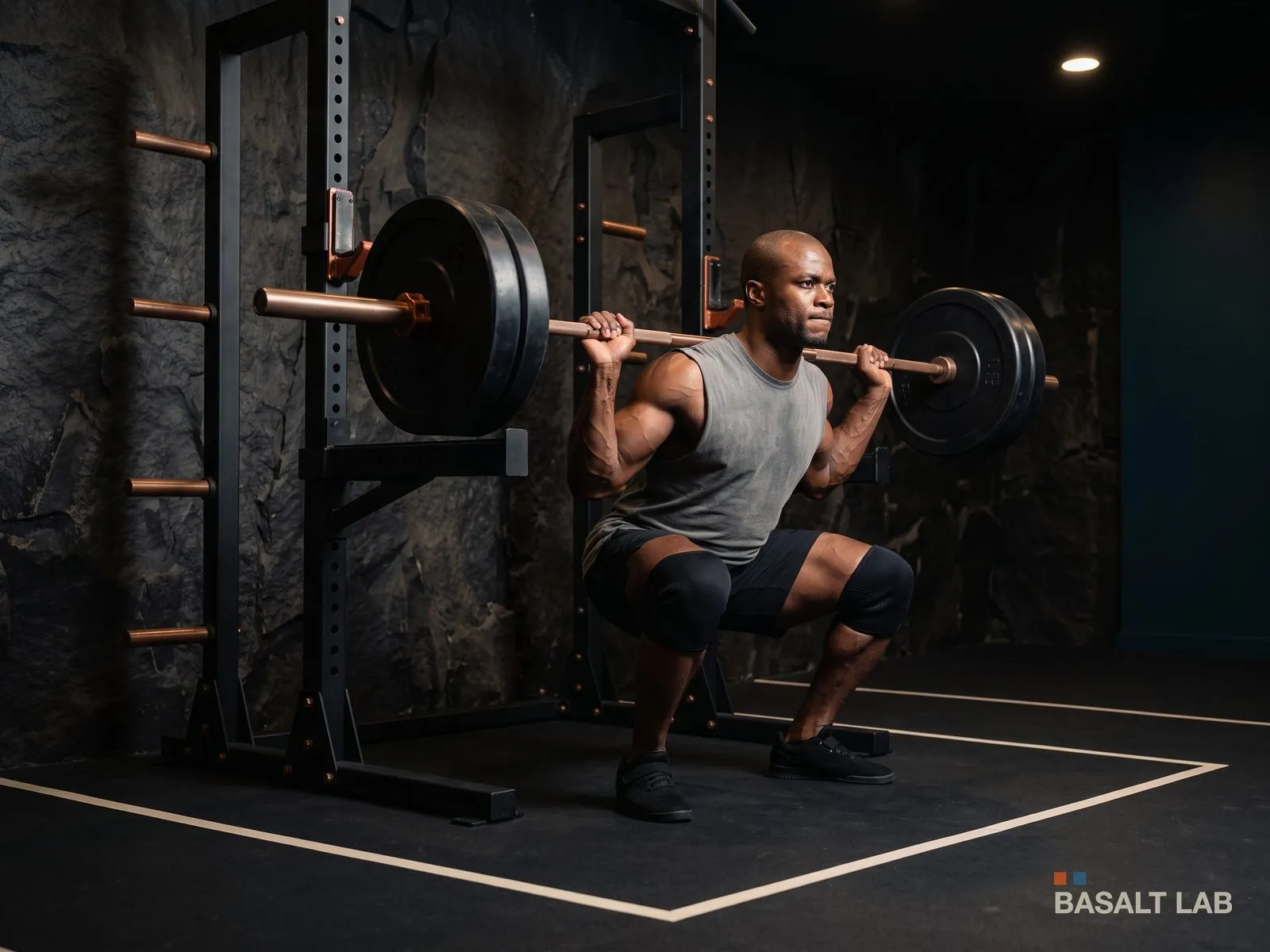
What the measurements show. In a ten-week study, training twice a week, lifters did either full squats or half squats. Their quads grew by the same amount in both groups, around 5%. But glute volume increased by 6.7% with the full squat against 2.2% with the half squat, and adductor volume by 6.2% against 2.7%.
What about the knees? A review of more than 160 publications concludes that the deep squat, learned properly and loaded progressively, does not increase the risk to ligaments, menisci or cartilage. Compression behind the kneecap peaks at around 90° of knee bend, then spreads out better as you go lower. The same review points the other way instead: half and quarter squats with very heavy loads, ones you could not take all the way down, put more stress on the knees and spine over the long term.
Your back sets the limit. If your lower back rounds at the bottom, stop just before that point. A slightly wider stance or toes turned out a little more is often enough to gain a few centimetres.
Knees: in line, and past your toes if needed
Your knees follow the direction of your toes all the way down and all the way up. They can travel past your toes: that is normal, and stopping them shifts the load to your hips and lower back.
Knees caving in. Seen from the front, your knee should not move inside your foot. When it caves, often on the way up and on the last reps, push your knees out, in line with your toes. If that is not enough, the weight is too heavy for today’s form.
Knees past the toes. The cue to keep your shins vertical comes from a good intention, protecting the knees, but it has a cost. In trained lifters, stopping the knees from moving forward raised the torque at the hip from about 28 to 303 N·m and made the torso lean much further forward. Let your knees travel as far as the movement needs.
Heels. They stay on the floor, from start to finish. Heels lifting off usually point to stiff ankles. Shoes with a raised heel, or a small plate under your heels at first, help while you work on mobility.
Breathing and bracing
Take a big breath at the top, fill your stomach and ribcage, hold it, go down, come up, and only breathe out once you are through the hardest part. Take your next breath at the top, before the following rep.
Holding your breath like this is called the Valsalva manoeuvre. It raises the pressure in your abdomen, which stiffens your trunk and helps stabilise your spine under the bar. With heavy loads, above roughly 80% of your max, or close to failure, it happens anyway. It raises your blood pressure during the effort; if you have high blood pressure or a heart condition, ask a health professional before training heavy.
Mistakes that cost you reps
| Mistake | What it costs | The fix |
|---|---|---|
| Cutting depth | Less work for the glutes, sessions you cannot compare | Go down at least to parallel |
| Knees caving in | The load shifts to the inside of the knee | Push the knees out in line with the toes |
| Heels lifting off | Lost balance, a torso that tips forward | Wider stance, raised heel |
| Lower back rounding | A spine that bears load less well | Stop the descent just before |
| Chest dropping on the way up | Hips rise alone, the back takes the load | Eyes ahead, drive your upper back into the bar |
| Losing your breath at the bottom | A trunk that goes soft at the worst moment | Breathe in at the top, hold through the hard part |
The most expensive one is the first. A load that goes up while your depth shrinks feels like progress, and the day you go all the way down again you drop back several steps.
Adding weight to your squat
Work within a rep range, for example three sets of six to ten, and only add weight once every set reaches the top of the range. On the squat the step is 5 kg in total, one 2.5 kg plate on each side. The full rule is here.
Volume. Count ten to twenty hard sets per week for your quads, variations and leg press included. How to count them works the same way for every muscle.
Effort. End most of your sets with two or three reps in reserve. On the squat more than anywhere else, fatigue is what makes the knees cave and the depth creep up. Reps in reserve are decided before the set, and the RPE chart turns that effort into a percentage of your max.
What you log. The weight, the reps and the reps in reserve of every working set. If you change your depth or bar position, log that too: they are two different exercises, and they do not compare.
Frequency. Two to three sessions a week, the rhythm of the beginner full body program. The more often the movement comes back, the faster it settles in.
Tools. The plate calculator tells you which plates go on each side, and the 1RM calculator estimates your max from a recent set, without having to test it.
If the load has not moved for three sessions, look at your sleep, your consistency and the real depth of your reps before changing program. That is the whole idea of progressive overload: you can only steer what you measure.
Variations worth doing
Keep a barbell squat as your main lift. Bar position and a few variations let you fit it to your body and your goal.
High bar or low bar. High bar, on your traps: your torso stays more upright, your knees bend more, you go deeper and your quads do more of the work. Low bar, across the back of your shoulders: your hips bend more, your torso leans further, and your glutes, adductors and back muscles take a bigger share. Pick one and stick with it: your numbers only mean something compared with themselves.
Front squat. The bar rests on the front of your shoulders. Your torso stays very upright and the load is usually lighter. In trained lifters it worked the muscles as much as the back squat, with less compression in the knee: a good option when your knees are sensitive.
Goblet squat. A dumbbell or kettlebell held against your chest. It is the best way to learn depth and knee alignment before moving to the bar.
Frequently asked questions
What muscles does the squat work?
Mainly the quads, the glutes and the adductors; your hamstrings, calves and back muscles stabilise the movement. A deeper squat gives the glutes and adductors more work, while the quads grow just as much with full squats as with half squats.
Are deep squats bad for your knees?
Not for a healthy knee, when the movement is learned properly and the load goes up gradually. Compression behind the kneecap peaks at around 90° of knee bend, then spreads out better lower down. Knee pain that persists needs to be examined by a health professional, not trained through.
Can your knees go past your toes when you squat?
Yes. Depending on your build and bar position, they travel more or less past your toes, and that is normal. Holding them back at all costs tips your torso forward and shifts the load to your hips and lower back. What matters is that they stay in line with your toes.
Do you need special shoes to squat?
Not to start with. A flat, firm sole is enough; avoid thick, soft running soles, which make your base unstable. Weightlifting shoes, with their raised heel, mainly help if your ankles are stiff and your heels lift off.
Do you need a spotter for squats?
The simplest option is to squat in a rack with safety bars set just below your lowest position: if a rep fails, you set the bar down on them. With neither safeties nor a spotter, keep at least two reps in reserve on every set.
Set the bar, plant your heels, keep your knees in line, go just as deep every time, and let the small steps do the rest.
Sources
- Effects of squat training with different depths on lower limb muscle volumes, Kubo, Ikebukuro and Yata, European Journal of Applied Physiology, 2019.
- Analysis of the load on the knee joint and vertebral column with changes in squatting depth and weight load, Hartmann, Wirth and Klusemann, Sports Medicine, 2013.
- Effect of knee position on hip and knee torques during the barbell squat, Fry, Smith and Schilling, Journal of Strength and Conditioning Research, 2003.
- The back squat: A proposed assessment of functional deficits and technical factors that limit performance, Myer et al., Strength and Conditioning Journal, 2014.
- A Review of the Biomechanical Differences Between the High-Bar and Low-Bar Back-Squat, Glassbrook et al., Journal of Strength and Conditioning Research, 2017.
- A biomechanical comparison of back and front squats in healthy trained individuals, Gullett et al., Journal of Strength and Conditioning Research, 2009.
- The Valsalva maneuver: its effect on intra-abdominal pressure and safety issues during resistance exercise, Hackett and Chow, Journal of Strength and Conditioning Research, 2013.
- Dose-response relationship between weekly resistance training volume and increases in muscle mass, Schoenfeld, Ogborn and Krieger, Journal of Sports Sciences, 2017.
- Application of the Repetitions in Reserve-Based Rating of Perceived Exertion Scale for Resistance Training, Helms et al., Strength and Conditioning Journal, 2016.