Beginner full body program, 3 sessions a week
A complete program in three weekly sessions: the exercises, the sets, the reps, and the rule for adding weight. Built for the first year, when almost everything works as long as you stay consistent.
A beginner full body program comes down to three sessions a week, six exercises per session, and one progression rule. You train the whole body every time, rest a day between sessions, and move up one step once every set reaches the top of the rep range two sessions in a row. That is enough for the first year, and it beats any complicated program you will not stick to.
Why full body to start
At equal volume, a 2019 meta-analysis of 25 studies finds no significant difference in muscle growth between training frequencies: training every muscle every session mostly spreads your sets. When you start out, technique matters as much as effort, and repeating the same movements often helps embed it: every exercise in the program comes round three times every two weeks.
The second argument is practical. If you miss one session in three, you have still trained the whole body twice. With a program split by muscle group, one missed session leaves a week-long hole.
The program
Three sessions a week, with at least one rest day between them. Monday, Wednesday, Friday, or Tuesday, Thursday, Saturday: whatever fits your week.
Session A
| Exercise | Sets | Reps |
|---|---|---|
| Squat | 3 | 6 to 10 |
| Bench press | 3 | 6 to 10 |
| Barbell row | 3 | 8 to 12 |
| Overhead press | 2 | 8 to 12 |
| Dumbbell curl | 2 | 10 to 15 |
| Plank | 3 | 30 to 45 seconds |
Session B
| Exercise | Sets | Reps |
|---|---|---|
| Romanian deadlift | 3 | 6 to 10 |
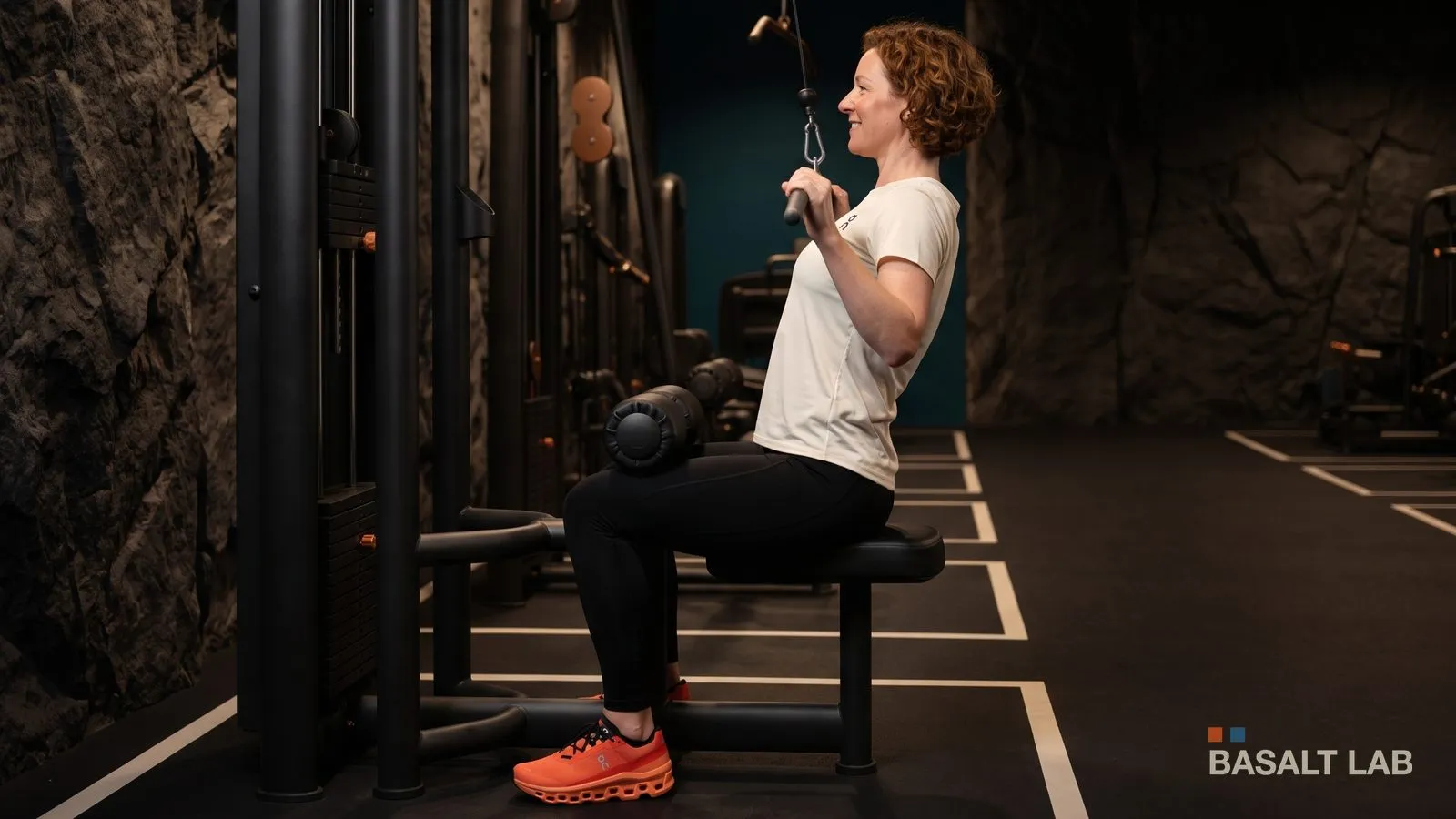
| Lat pulldown or assisted pull-up | 3 | 8 to 12 |
| Incline dumbbell press | 3 | 8 to 12 |
| Walking lunges | 2 | 10 to 12 per leg |
| Triceps extension | 2 | 10 to 15 |
| Standing calf raise | 3 | 12 to 15 |
Alternate A and B from one session to the next. Over two weeks, each session comes round three times. You do not need more variety: progress comes from the weight, not from the number of different exercises.
How to add weight
Stay on the same weight until you hit the top of the range on every set. Once that happens two sessions in a row, move up one step and start again from the bottom. That is the whole rule, covered in when to add weight.
The step is the smallest plate available: five kilos total on the squat and deadlift, two and a half on upper body lifts. The plate calculator tells you what to put on the bar.
For starting weights, deliberately start too light. The first week is for finding the movement, not for proving anything. You will climb fast, and faster still for not having had to come back down.
The warm-up
Five minutes on a bike or a rower, then a ramp on the first heavy lift of the session: the empty bar, then two or three progressively heavier and shorter sets. The following exercises do not need their own warm-up, the body is already warm. For the exact loads, the warm-up sets calculator starts from your working weight.
Warm-up sets do not count towards your volume. They are not a stretching session either: stay short, climb quickly.
How long a session takes
Count an hour to an hour and a quarter, warm-up included. Rest between sets is what sets the length: two to three minutes on the squat, bench and row, a minute to a minute and a half on everything else.
If you are short on time, cut isolation exercises rather than rest. A set done with thirty seconds of recovery is not the same set.
What it adds up to in volume
Counted in full sets, the program gives chest and back 9 sets a week, and quads 7 or 8 depending on the week: the bottom of the 8 to 12 set benchmark for a first year, or just below it. The arithmetic is in how many sets per muscle per week.
That is deliberate. You will progress on it for months, and you keep room to add volume when the weight stops climbing on its own.
When to change programs
Not before six months, and not because you are bored. The two valid signals are progress stalling on several exercises despite a lighter week, and wanting to train more than three times a week.
At that point the question is not which fashionable program to try, but how to spread more work across more sessions. That is the subject of full body or split.
Frequently asked questions
Can I train four times a week instead of three?
Yes, alternating A and B without thinking about it. Four weekly full body sessions work well, as long as you keep a rest day between them and do not increase the number of sets at the same time.
Should I do cardio as well?
It does not stop you progressing as long as it stays moderate and away from your strength sessions. Walking, cycling, swimming, two or three times a week without chasing performance, costs progress nothing.
What if I cannot squat or deadlift?
Swap in a leg press and a deadlift on a guided bar or with dumbbells. The program works with variations: what matters is repeating the same movement, not doing the prestigious one.
How long before I see results?
The weights move within the first few weeks, because the nervous system adapts quickly. Visible changes take several months, and depend as much on food and sleep as on training.
Three sessions, six exercises, one rule. The rest is consistency.
Sources
- How many times per week should a muscle be trained to maximize muscle hypertrophy? A systematic review and meta-analysis of studies examining the effects of resistance training frequency, Schoenfeld, Grgic and Krieger, Journal of Sports Sciences, 2019.