Deadlift without a barbell: dumbbells and kettlebells
No barbell? The dumbbell Romanian deadlift, its single-leg version and the kettlebell swing, with the loads measured in a study and what six weeks of swings did for strength.
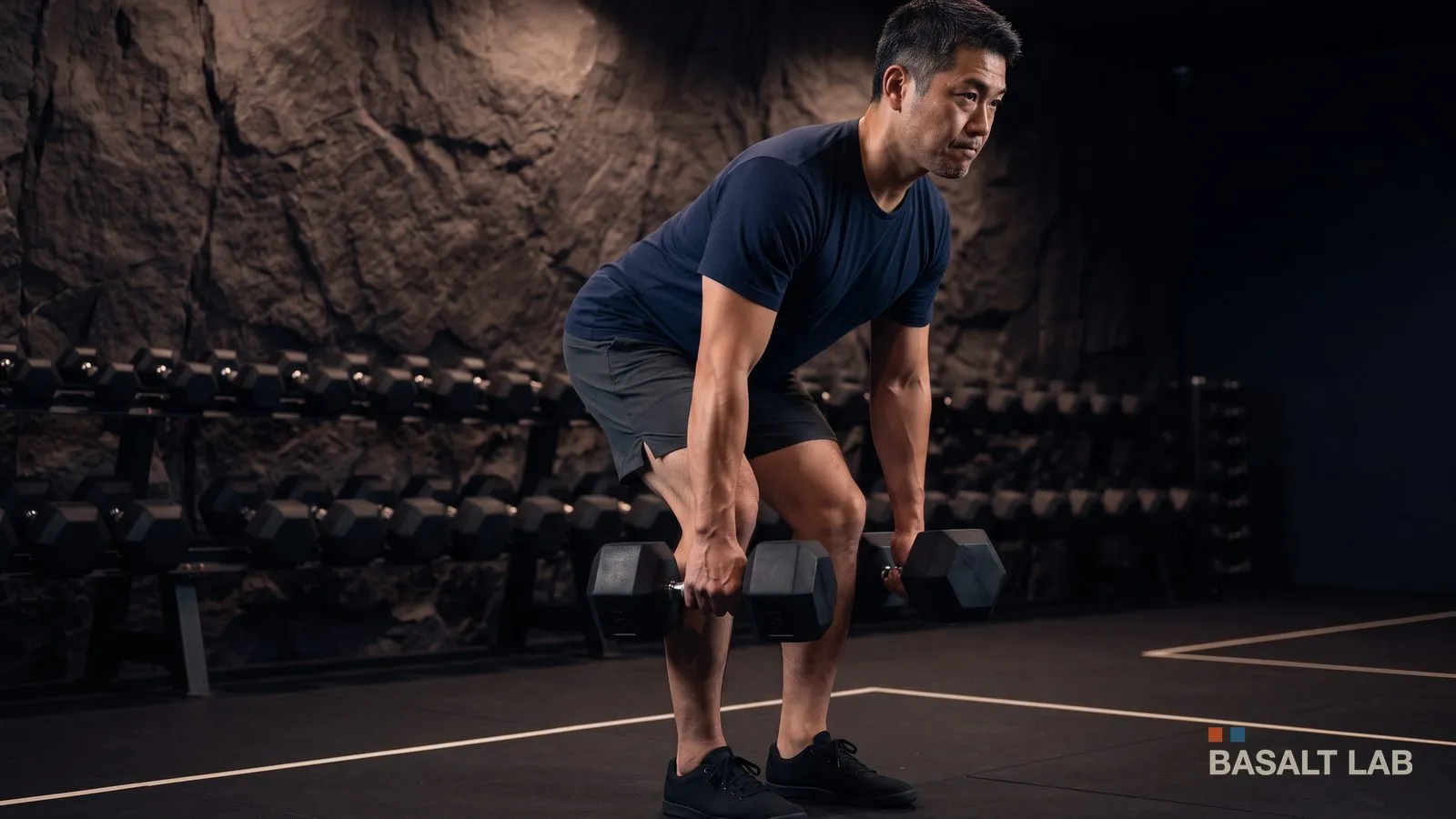
Without a barbell, the deadlift is replaced by the dumbbell Romanian deadlift, then by its single-leg version once the dumbbells feel too light. Here is how much these variations really load you, and what the kettlebell swing is worth for your strength.
In short
- In a study of 15 trained lifters, the heaviest load for 8 reps on one leg was 56% of the conventional deadlift load.
- Two 20 kg dumbbells on one leg are therefore roughly as hard as a 72 kg barbell on two legs.
- Six weeks of kettlebell swings, twice a week, raised maximal strength by 9.8% in a 2012 trial.
At home, the deadlift is hard to replace: it loads heavy, and a pair of 10 or 20 kg dumbbells looks tiny next to a 100 kg barbell. You can still deadlift without a barbell, as long as you change how the movement is loaded. Basalt Lab took the loads measured in a German study to work out what your dumbbells are really worth.
Also read: Deadlift form: setup, safety and progression
The dumbbell Romanian deadlift keeps the deadlift movement
The movement that matters is the hip hinge: hips go back, back stays flat, and the dumbbells slide down your thighs until you feel the back of your thighs stretch. The Romanian deadlift reproduces exactly that, without having to break a load off the floor.
| Your equipment | The exercise | What it gives you |
|---|---|---|
| Two light dumbbells | Romanian deadlift, then in a staggered stance | The movement, and a step towards one leg |
| Two heavy dumbbells | Single-leg Romanian deadlift | Twice the load on each leg |
| One kettlebell | Kettlebell swing | Speed and hip strength |
| Nothing | Single-leg glute bridge, single-leg deadlift | Glutes and balance, at a low load |
When two dumbbells get too light, step one foot back half a foot length and keep only the toes on the floor. This staggered stance puts most of the work on the front leg while keeping balance easy.
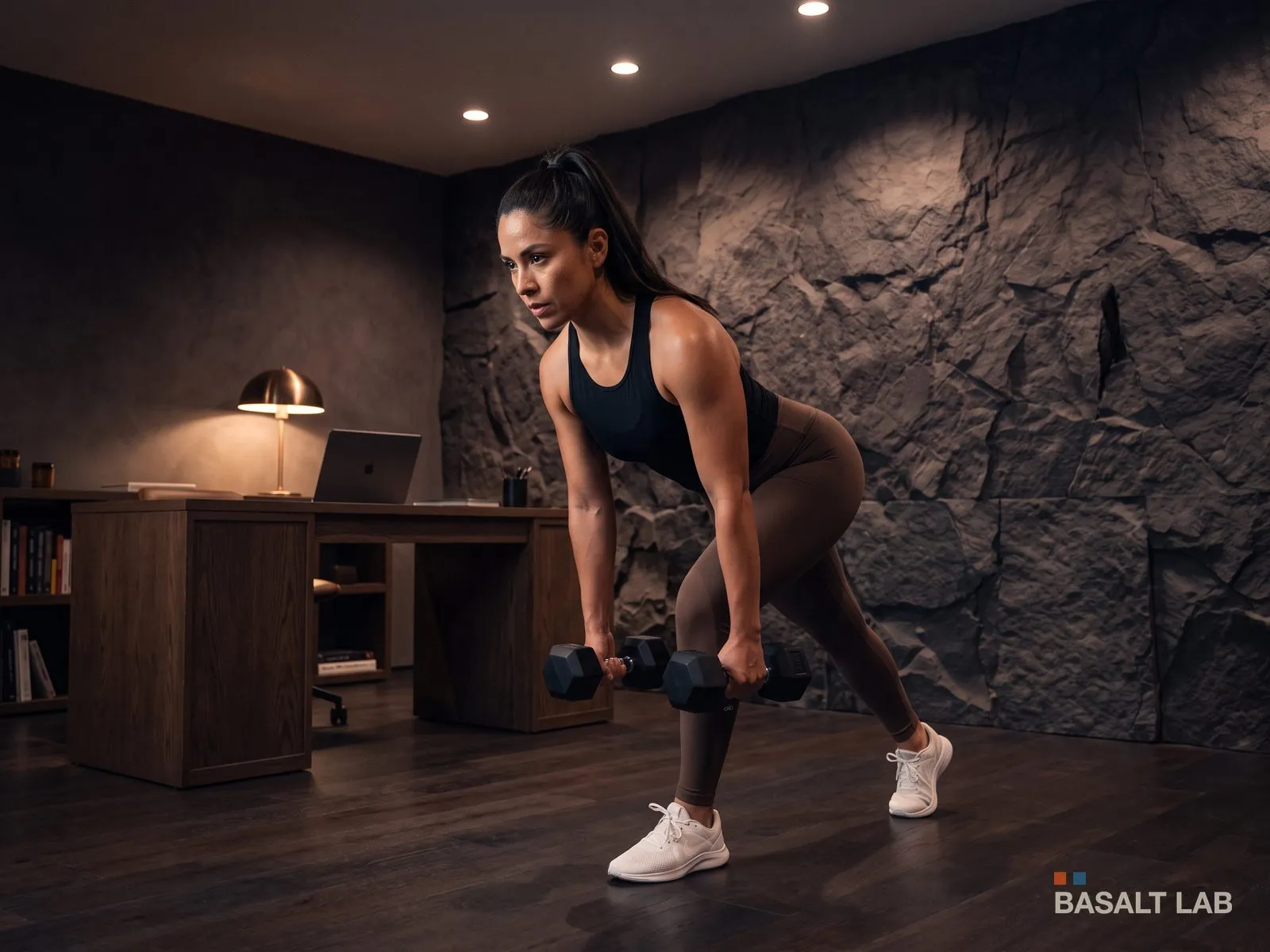
On one leg, two 20 kg dumbbells equal a 72 kg barbell
In 2021, a team from the German Sport University Cologne had 15 trained men perform the conventional deadlift and its single-leg version, each with the load they could lift 8 times. The averages: 112.8 kg on two legs, 62.7 kg on one leg. On one leg, you lift about 56% of your usual load.
What your dumbbells are worth. Divide the total weight of your dumbbells by 0.56: you get roughly the barbell you would lift 8 times on two legs for the same effort. Two 10 kg dumbbells equal a 36 kg barbell, two 20 kg dumbbells a 72 kg barbell, two 24 kg kettlebells an 86 kg barbell.
The same study measured muscle activity. On one leg, the gluteus medius and the biceps femoris, at the back of the thigh, worked harder; the lower back muscles slightly less on one side. Treat these equivalents as a ballpark: the average of 15 people is not your own ratio, and balance often limits the first sessions.
Kettlebell swings built strength in six weeks
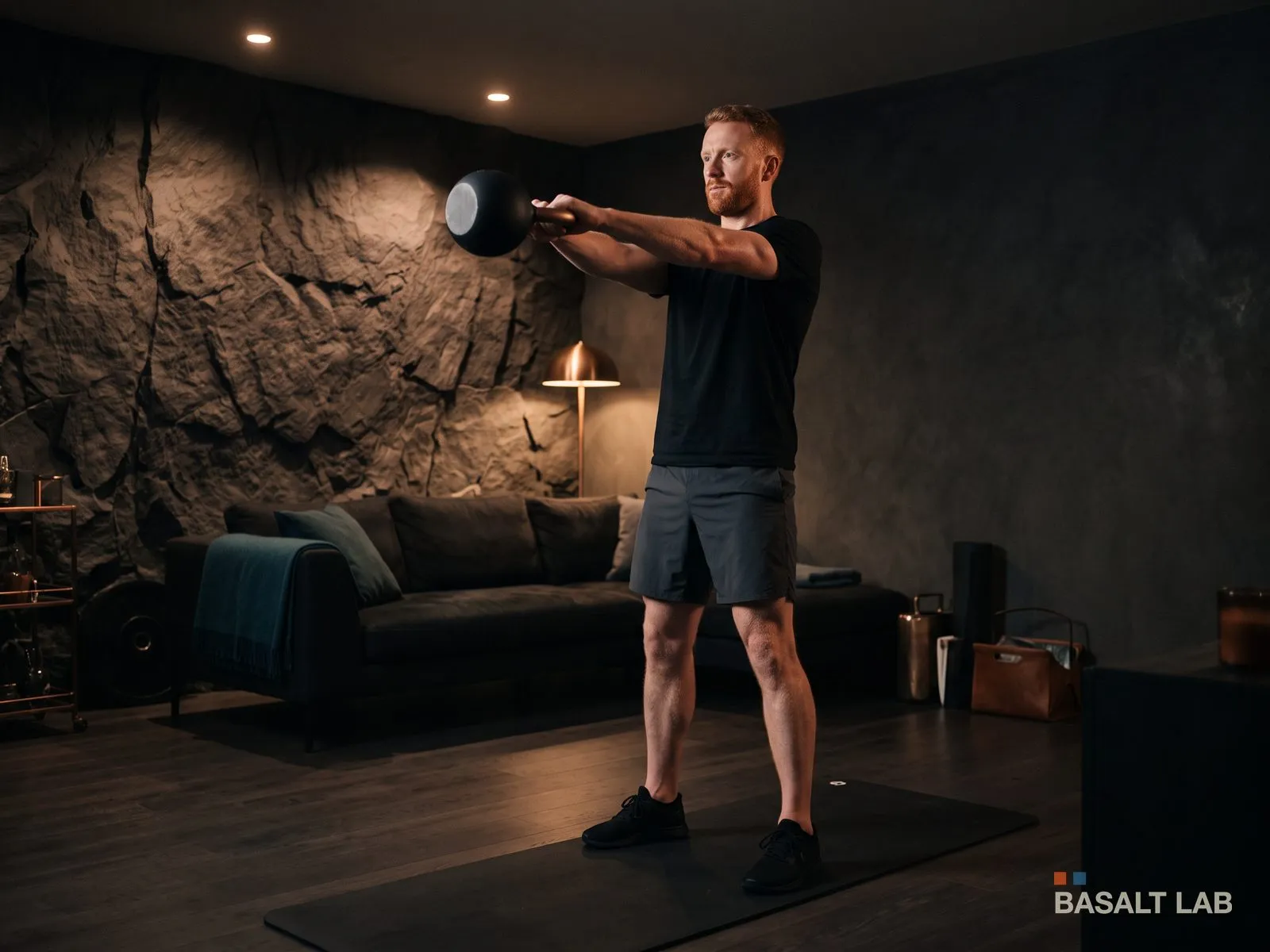
With a single kettlebell, the swing is the other option. Your hips drive the load forward to chest height, then let it fall back between your legs. The movement is fast and the load light, but Lake and Lauder’s British trial in 2012 measured what it does for strength.
Twenty-one men trained twice a week for six weeks: either 12 minutes of swings, alternating 30 seconds of work and 30 seconds of rest with 12 or 16 kg depending on their body weight, or loaded jump squats. Maximal half-squat strength rose by 9.8% on average, with no difference between the two groups.
Its limits. In another six-week trial the same year, a weightlifting and barbell squat program built more strength than kettlebell work. The swing maintains and develops strength; it does not replace a heavy barbell over the long run.
At the lower back, a 16 kg swing produced about 3,200 newtons of compression: most people tolerate it well, but pain that keeps coming back should be checked by a health professional.
To track progress without a barbell, stick to the same variation
A variation only compares with itself. Log the exact exercise, the dumbbells used and your foot position, then add reps first, and load once every set reaches the top of your rep range two sessions in a row, as the article on when to add weight explains. On one leg, one set per side counts as one set in your sets per week.
In Basalt Lab, you swap an exercise mid-workout from 500 of them, and each set takes a few taps to log, on your iPhone or on your wrist with Apple Watch. The same approach works for the squat without a barbell and the bench press without a bench.
Frequently asked questions
Can you do deadlifts without a barbell?
Yes. The dumbbell Romanian deadlift keeps the same movement, and its single-leg version doubles the load each leg carries. With a single kettlebell, the swing also trains your hips and glutes.
What exercise can replace the deadlift?
With dumbbells, the single-leg Romanian deadlift: in the 2021 study, it took the same effort as a conventional deadlift with 56% of the load. With no equipment, the single-leg glute bridge keeps your glutes working.
Dumbbell or barbell deadlift?
The barbell lets you load heavier, so it takes your max further. Dumbbells are enough for a stretch without a barbell, especially on one leg, and they teach the hip hinge well.
Sources
- Comparison of EMG activity between single-leg deadlift and conventional bilateral deadlift in trained amateur athletes: an empirical analysis, Diamant, Geisler, Havers and Knicker, International Journal of Exercise Science, 2021.
- Kettlebell swing training improves maximal and explosive strength, Lake and Lauder, Journal of Strength and Conditioning Research, 2012.
- Effects of weightlifting vs. kettlebell training on vertical jump, strength, and body composition, Otto, Coburn, Brown and Spiering, Journal of Strength and Conditioning Research, 2012.
- Kettlebell swing, snatch, and bottoms-up carry: back and hip muscle activation, motion, and low back loads, McGill and Marshall, Journal of Strength and Conditioning Research, 2012.