Squat without a barbell: the best alternatives
No barbell or rack? The Bulgarian split squat, the goblet squat and the single-leg squat, with the load each leg actually carries and what the trial that compared them to the squat found.
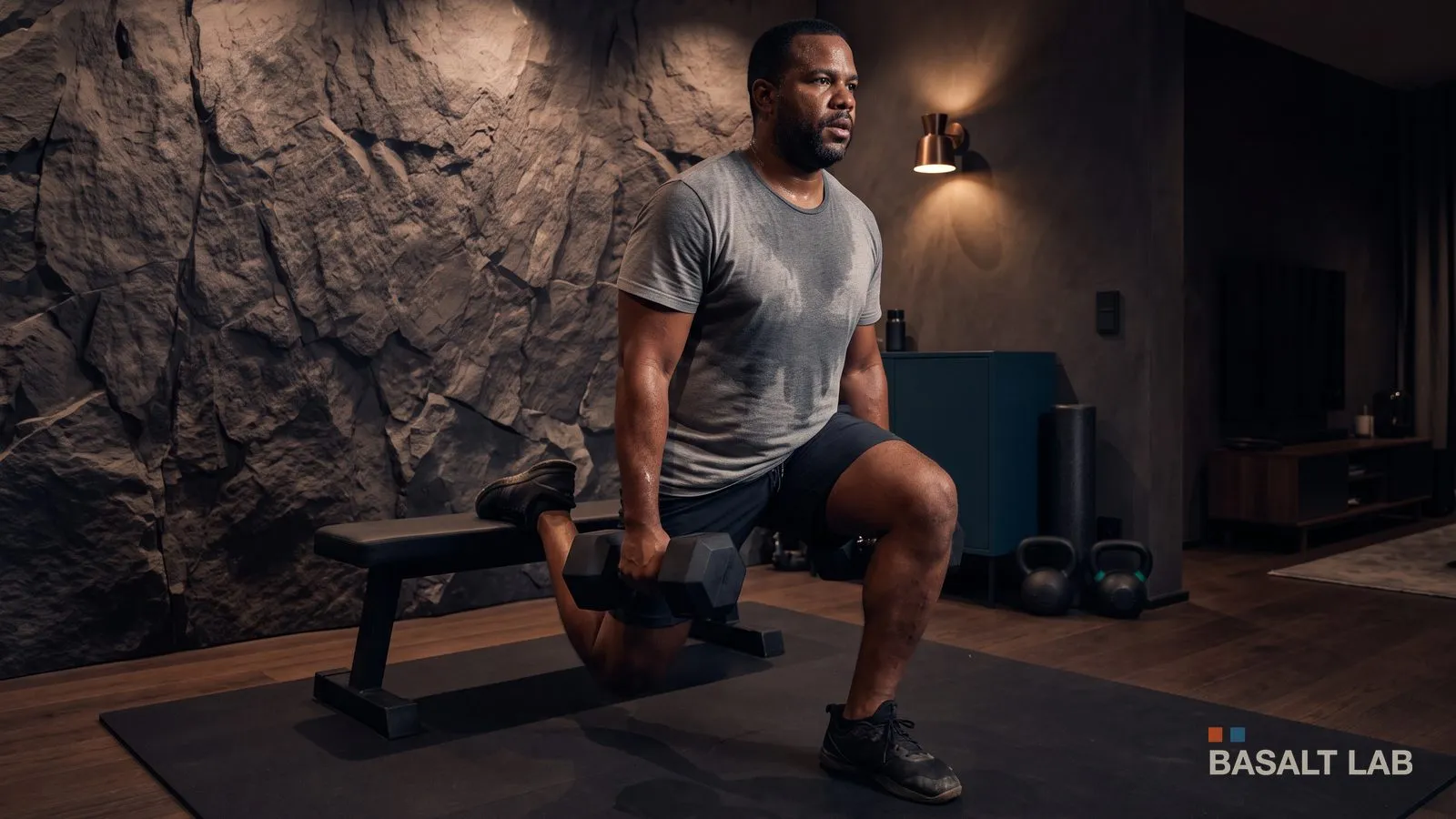
Without a barbell, the best replacement for the squat is the Bulgarian split squat: rear foot on a chair or a bench, a dumbbell in each hand, you lower yourself on the front leg. The goblet squat, one dumbbell held against your chest, is for learning the movement and for light loads. With no equipment at all, the single-leg squat takes over.
People love the barbell squat because it loads heavy. Without a barbell, that is the whole problem: with two 10 kg dumbbells, it feels like light training. The calculation below shows that it stops being light as soon as you move to one leg, and the trial after it shows what that switch does for your squat strength.
The Bulgarian split squat: one leg carries almost everything
In the Bulgarian split squat, the front leg does the work and the rear leg mostly helps you balance. That is what makes it the most effective squat replacement when all you have is dumbbells.
In 2020, a British team put a force plate under each foot of 26 trained men, across 715 reps, from warm-up sets up to their five-rep max. The front leg produced 84.4% of the total vertical force on average. The rear foot’s share did not change with the load: the authors put it down to the weight of the rear leg, not to any pushing effort.
How much your front leg carries. In a barbell squat, each foot carries half of your bodyweight plus the bar. In a Bulgarian split squat, the front leg carries 84.4% of it. For a 75 kg person, the unloaded Bulgarian split squat already puts 63 kg on the front leg, as much as each leg carries in a squat with a 52 kg bar. With two 10 kg dumbbells, that rises to 80 kg per leg, the equivalent of an 85 kg bar; with two 20 kg dumbbells, 97 kg per leg, the equivalent of a 119 kg bar.
The setup. Rear foot resting on its laces on a stable support, roughly knee height; the study used 40 cm. Front foot far enough forward that the heel stays down for the whole descent. Lower until the rear knee nears the floor.
The goblet squat: the simplest, soon too light
The goblet squat keeps the two-legged squat pattern: a dumbbell or a kettlebell held upright against your chest, you sit down between your heels. It is the best exercise for learning depth and knee tracking, as the guide to squat technique points out.
Its limit is your arms. Both legs share the load as in a barbell squat, so a 20 kg dumbbell counts as a 20 kg bar. Before your legs tire, it is often your arms and upper back that give up on holding the dumbbell.
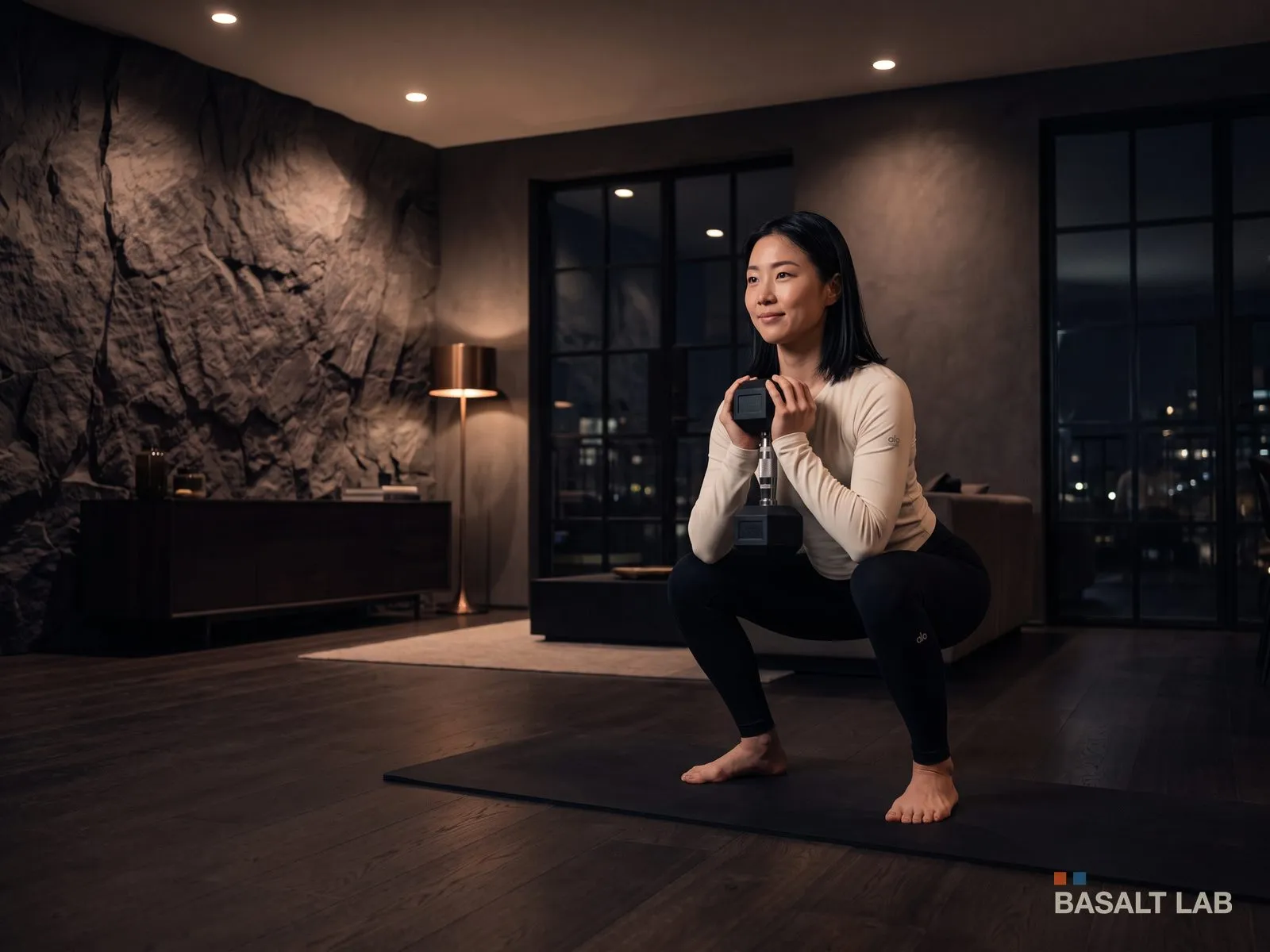
Making it harder without more weight. Take three seconds on the way down, pause for two seconds at the bottom, or add a half rep before you stand up. The muscle works longer on every rep.
No equipment: the single-leg squat
Without dumbbells, moving to one leg doubles the load on each leg. The single-leg squat, the other leg straight out in front, puts all your weight on the standing leg: for 75 kg, as much as a 75 kg bar in a squat.
It is also the hardest exercise in this article, for balance as much as mobility. Start by sitting down on a chair on one leg and standing back up, then lower the seat week after week. The unloaded Bulgarian split squat, at a 52 kg equivalent, makes a good step in between.
The step-up onto a chair. One foot on a stable chair, you step up without pushing off the leg left on the floor. The higher the step, the more your knee bends at the start and the more the exercise looks like the bottom of a squat.
What the trial that compared them found
Training one leg at a time does not cost you squat strength, at least over a few weeks. That is the conclusion of a controlled trial that replaced all squat work with the Bulgarian split squat.
In 2016, 18 young rugby players were randomized into two groups for five weeks, two sessions a week: barbell squat only, or Bulgarian split squat only. Both groups followed the same sets, from four sets of six reps at 75% of max up to four sets of three at 92%. Squat max rose by 5.7% in the split squat group and by 5.0% in the squat group, with no significant difference between them. Split squat max rose by 9.2% and 10.5%.
Its limits. Eighteen trained players, five weeks: that is short and small. The trial shows that the Bulgarian split squat maintains and builds squat strength through a stretch without a barbell, not that it replaces the squat for good.
At the gym, when the rack is taken
If the gym has dumbbells, the Bulgarian split squat works just as well as at home, with heavier loads. The leg press is the other option: it loads heavy with no bar on your back and no balance to hold.
Stick with the same exercise from one session to the next rather than taking whatever is free that day. Otherwise your sets no longer compare, and you can no longer tell when to add weight.
Keeping your progress measurable
Switching exercises does not break your progress, as long as you keep the same reference points. A Bulgarian split squat only compares with a Bulgarian split squat done on the same support.
Log the variation and the setup. Support height, distance between your feet, dumbbells used: that is what lets you apply progressive overload without a squat bar.
Make it harder in this order. First more reps, then heavier dumbbells, then a pause at the bottom of every rep. Always do the same number of reps on each leg, starting with the weaker one.
Count your sets. A set done on each side counts as one full hard set for your quads and as half a set for your glutes. Your sets per week then add up just as they do with the squat. The same principle applies to your upper body, with the bench press without a bench and pull-ups without a bar.
Frequently asked questions
Can you build your legs without a barbell?
Yes. The Bulgarian split squat, the goblet squat and the single-leg squat all train the quads and glutes. What matters is a load heavy enough to end each set close to failure, raised week after week.
Does the Bulgarian split squat replace the squat?
Over a few weeks, yes: in the 2016 trial, five weeks of split squats alone raised squat max as much as the squat itself. It will not teach you to carry a bar on your back, though: keep squatting if the squat is the lift you want to build in the long run.
What dumbbells should I use for Bulgarian split squats?
For a 75 kg person who squats 100 kg, the same load per leg comes from two dumbbells of about 15 kg. Start lighter: balance holds you back in the first sessions, and the load climbs fast once the movement is steady.
Are Bulgarian split squats bad for your knees?
They should not be, if the front heel stays down and the knee tracks over the foot. Shorten the descent while you find your position. If knee pain persists, have it checked by a health professional.
No barbell is no reason to skip legs: move to one leg, set the load, and log it every week.
Sources
- Is the rear foot elevated split squat unilateral? An investigation into the kinetic and kinematic demands, Helme, Emmonds and Low, Journal of Strength and Conditioning Research, 2022 (online 2020).
- Unilateral vs. bilateral squat training for strength, sprints, and agility in academy rugby players, Speirs, Bennett, Finn and Turner, Journal of Strength and Conditioning Research, 2016.