Bench press without a bench: what to do instead
No bench at home, or every bench is taken? Push-ups loaded to your bodyweight, the floor press and the gym options, with what the studies show and how to keep your progress on track.
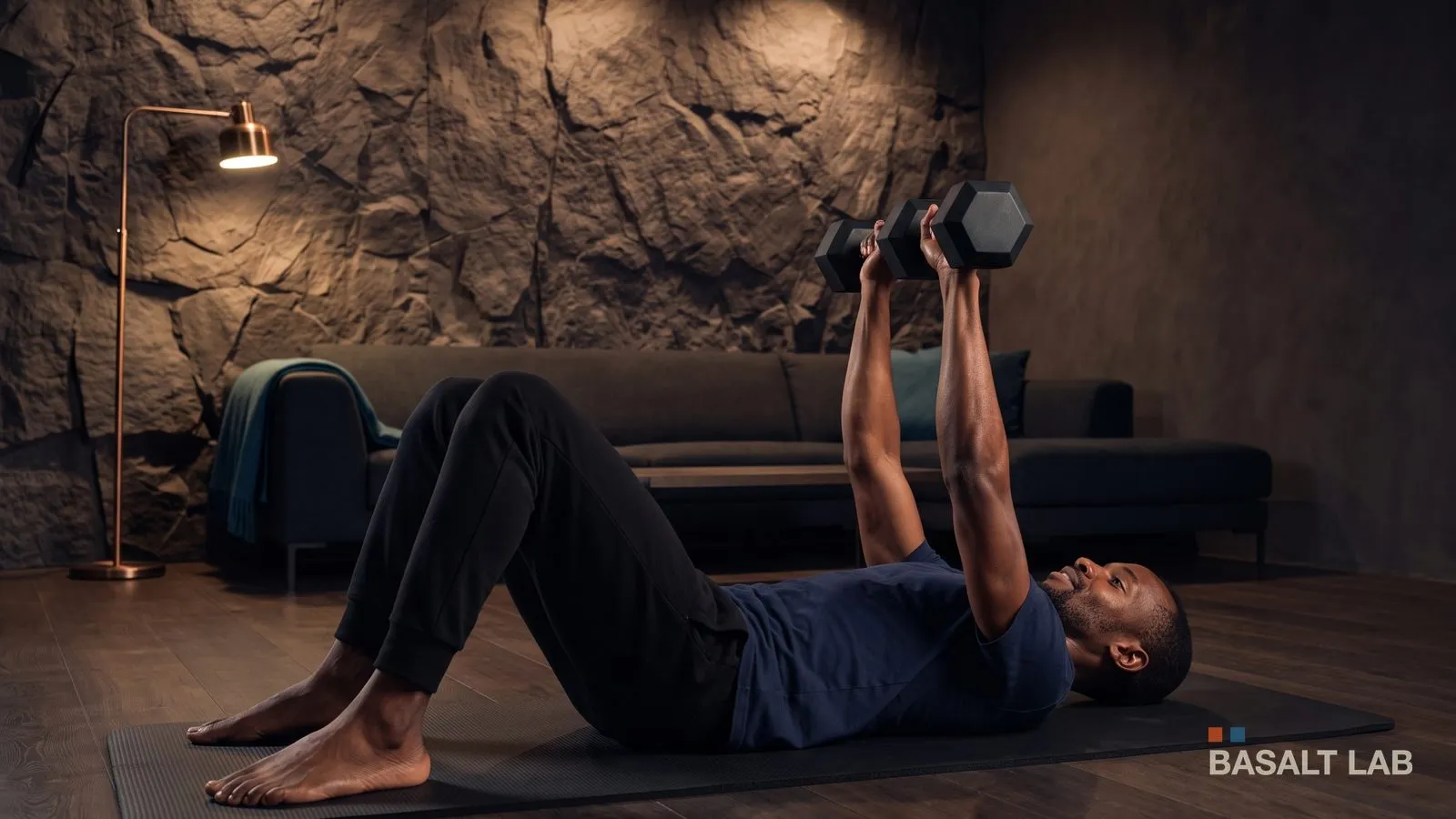
Without a bench, the closest replacement for the bench press is the push-up, as long as you load it enough to finish each set close to failure. If you own dumbbells or a barbell, the floor press covers the rest. At the gym, when every bench is taken, dips, the cable press and the chest press machine train the same movement pattern.
Your chest and triceps don’t know what you’re lying on: what makes them grow is a heavy enough press, repeated week after week. Two controlled trials have tested this with push-ups, and the calculation below tells you how much load you actually press from the floor.
Push-ups: the closest replacement
Push-ups train the same muscles as the bench press, and two studies show they build strength just as well when the load is comparable. Their limit lies elsewhere: your bodyweight sets the load, so you need ways to adjust it.
In 2017, a Japanese study followed 18 young men for eight weeks, two sessions a week. Half did the bench press at 40% of their max, the other half did push-ups set to an equivalent load, every set taken to failure. Both groups gained strength and chest and triceps thickness, with comparable results.
A Spanish study from 2015 went heavier, with 30 students who already lifted. For five weeks, one group did the bench press at a 6-rep max, the other did push-ups with a resistance band tuned to the same effort. Both improved their max and their 6-rep sets by similar amounts.
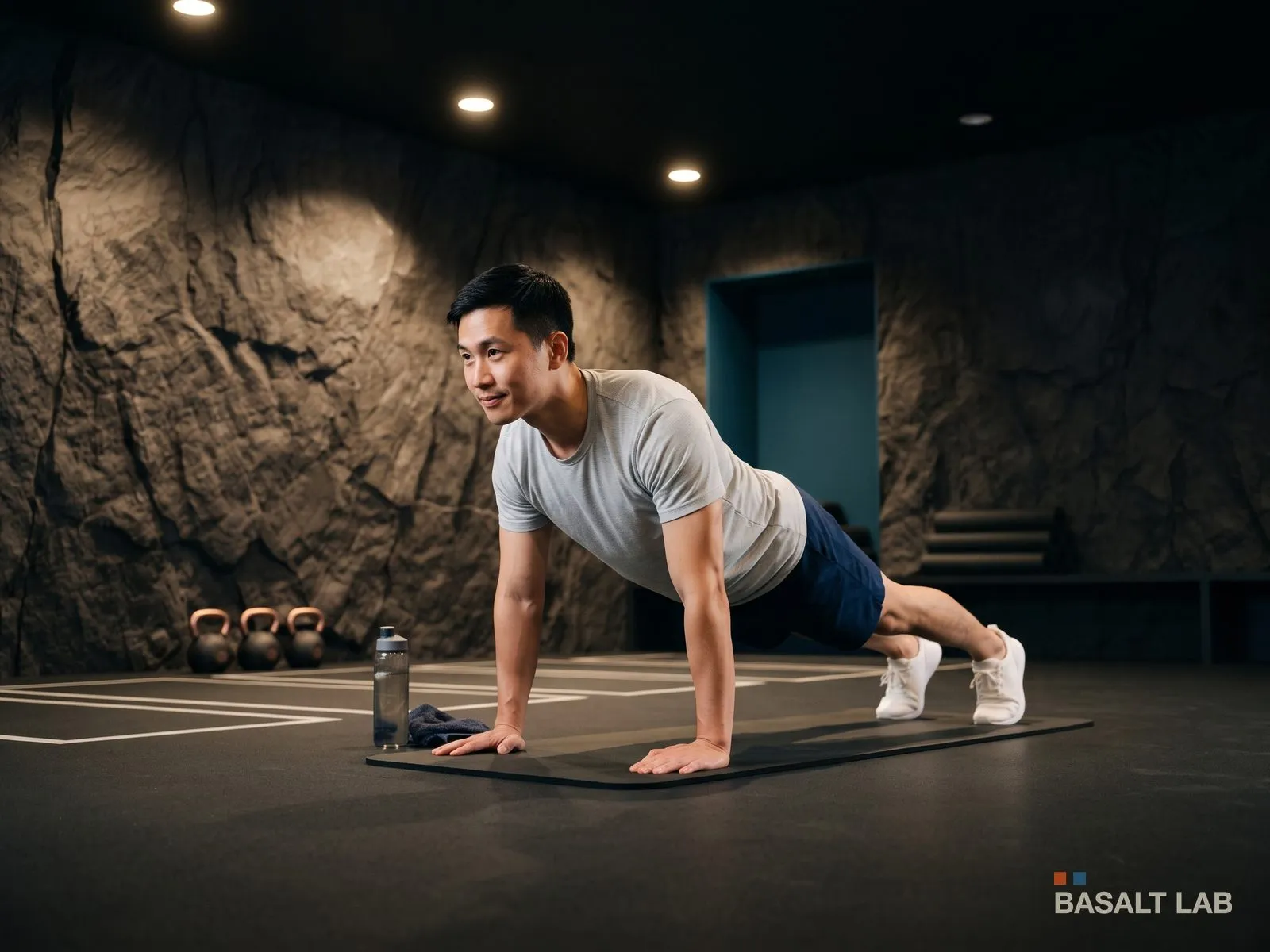
How much you actually press. Force plate measurements put about 64% of bodyweight on the hands in a regular push-up, and 49% in a push-up from the knees. Applied to a few bodyweights, those percentages give a rough idea of your load.
| Your bodyweight | Regular push-up (64%) | Knee push-up (49%) |
|---|---|---|
| 60 kg | 38 kg | 29 kg |
| 70 kg | 45 kg | 34 kg |
| 80 kg | 51 kg | 39 kg |
| 90 kg | 58 kg | 44 kg |
Compare that number with your bench press max. Someone weighing 75 kg presses about 48 kg per push-up: with an 80 kg max, that is around 60% of their max, enough to make progress if sets go close to failure. With a 120 kg max, it is 40%: push-ups still help, but they will need extra load.
Making push-ups heavier
Once you can do more than twenty-five clean push-ups, sets get long and hard to push to the end. The authors of the 2017 study point out that light loads build muscle almost as well as heavy ones, but strength improves more slowly with them. Add reps within your rep range first; once you hit the top of it two sessions in a row, make each rep heavier.
Feet elevated. In force measurements, push-ups with the feet on a box loaded the hands more than the regular push-up and every other variation tested. It is the first step up, with no equipment at all.
Added weight. A backpack filled with books or water bottles, or a plate placed between your shoulder blades by a training partner. You add kilograms the way you would on the bar, in small steps, and you know exactly what you added.
A resistance band. Looped across your back and held under your hands, it makes the top of the press harder. That is the setup from the 2015 study, which adjusted it to match the effort of a 6-rep bench press set.
Tempo. Three seconds on the way down and a one-second pause at the bottom add time under tension without equipment. It is the fallback when nothing else is available.
Going the other way, hands on a table or knees on the floor make the push-up lighter: that is the entry point if ten regular push-ups are still out of reach.
The floor press, if you have dumbbells
Lying on your back, knees bent and feet flat, you press the dumbbells as you would on a bench, but your elbows stop on the floor. The range of motion is shorter, and the top of the press, where the triceps work hardest, becomes the hard part.
Setup. Shoulder blades pinched against the floor, elbows neither tucked in nor flared out to 90 degrees, just like on the bench. No study sets an ideal angle: this is a common guideline, not a rule. Lower the dumbbells until your upper arms touch the floor.
No bounce. Pause briefly with your elbows down, then press. The floor should not send the weight back up, or the rep gets easier than it looks.
Dumbbells rather than a barbell. A loaded barbell is awkward to get into position from the floor without a rack. Two dumbbells rest on your thighs, then roll into place on their own.
Treat it as a separate exercise: with a different range of motion, its loads don’t compare with your bench press numbers.
At the gym, when the bench is taken
If every bench is busy, there is no need to change your workout: other stations cover a similar press.
Dips. On parallel bars, torso leaning slightly forward, they load the chest and triceps hard. Only go as deep as your shoulders stay comfortable.
Standing cable or band press. A 2014 study compared push-ups, the bench press and the standing cable press: banded push-ups activated the main pressing muscles as much as a heavy bench press, with more work for the abs.
The chest press machine. Seated, with a guided path, it loads heavy and needs no spotter. It is the simplest replacement when you want to keep your heavy sets.
As soon as a bench frees up, the incline and dumbbell presses described in the bench press guide take their place again.
Keeping your progress comparable
Switching exercises does not break your progress, as long as you don’t mix up the numbers. A set of weighted push-ups only compares with the weighted push-ups of previous weeks.
Log the variation. Feet-elevated push-ups, floor press, machine: each one gets its own record of loads and reps. That is what lets you apply progressive overload to the variation you picked.
Count your sets. For weekly volume, a hard set of push-ups or floor press counts as a set of bench press. Your sets per week add up the same way, and so does your push to pull ratio.
Back on the bench. After a few weeks without a barbell, don’t jump straight back to your last load. Do a set of 5 to 8 reps with two reps in reserve, and enter it into the 1RM calculator to start again from an up-to-date max.
Frequently asked questions
Can you build your chest without a bench?
Yes. The studies that compared push-ups with the bench press measured similar gains in chest thickness, provided sets went close to failure. A bench makes the load easy to set, but your muscles don’t need it.
How many push-ups equal a bench press?
There is no fixed number. A regular push-up has you pressing about 64% of your bodyweight. Compare that load with your max: if it falls below roughly 40%, add weight, raise your feet or move to a harder variation so your sets stay short and hard.
Does the floor press really replace the bench press?
For the most part. It trains the same muscles over a shorter range, without the stretch at the bottom of the movement. It works well for a few weeks without a bench, or alongside the bench press once you have one again.
Can you bench press on a stability ball or a chair?
Avoid unstable or fragile supports with heavy loads. The floor is stable and you cannot fall off it. If shoulder pain shows up whatever the variation, reduce the load and get it checked by a healthcare professional.
No bench is no reason to skip your pressing: pick a variation, load it enough, and log it every week.
Sources
- Low-load bench press and push-up induce similar muscle hypertrophy and strength gain, Kikuchi and Nakazato, Journal of Exercise Science & Fitness, 2017.
- Bench press and push-up at comparable levels of muscle activity results in similar strength gains, Calatayud, Borreani, Colado, Martin, Tella and Andersen, Journal of Strength and Conditioning Research, 2015.
- Kinetic analysis of several variations of push-ups, Ebben, Wurm, VanderZanden, Spadavecchia, Durocher, Bickham and Petushek, Journal of Strength and Conditioning Research, 2011.
- Muscle activity levels in upper-body push exercises with different loads and stability conditions, Calatayud, Borreani, Colado, Martin and Rogers, The Physician and Sportsmedicine, 2014.