Deadlift form: setup, safety and progression
Where to put your feet and hands, how to keep your back neutral, when to breathe and which variation to pick: deadlift form, the mistakes that cost the most, and a way to progress without needless risk.
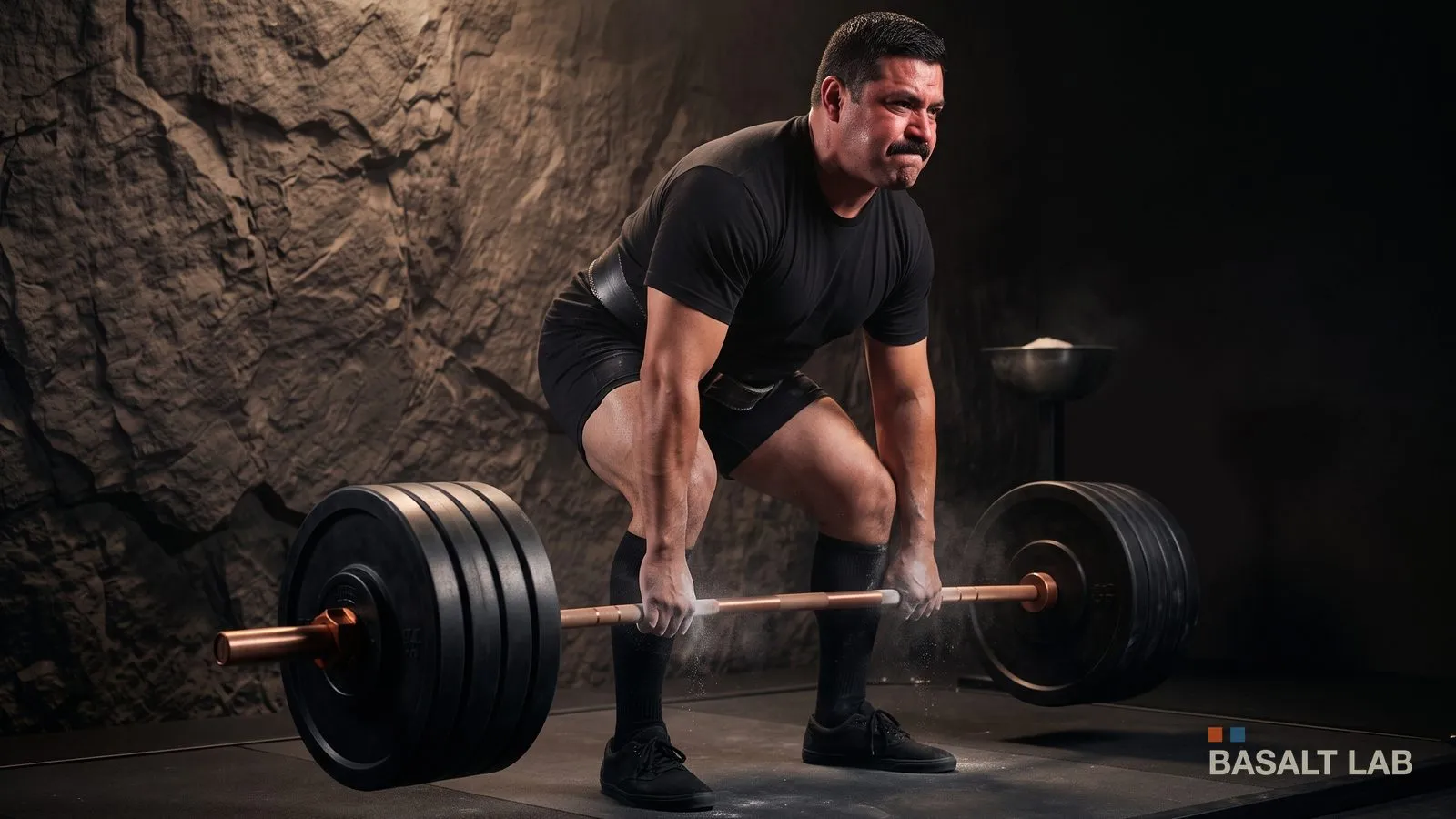
Good deadlift form comes down to four adjustments: the bar over the middle of your foot, hands just outside your legs, your back locked in its natural curve before the bar leaves the floor, and a bar that travels up against your legs in a straight line. Once those are in place, safety comes mostly from the load: it goes up in small steps, and only when your form holds on every rep.
The deadlift scares people because of the lower back. The research says something more nuanced: the lift puts a heavy load on the spine, but it is a movement the body can learn, as long as you do not skip steps.
Setting up: feet, grip, bar
Before you pull, set three things: where your feet are, where your hands are, and how far the bar sits from your shins. They stay the same on every rep, which is what makes your sessions comparable.
Feet. In a conventional deadlift, heels are roughly hip-width apart, toes straight or turned slightly out. Seen from above, the bar sits over the middle of your foot, two or three centimetres from your shins.
Grip. Hands go just outside your legs, arms straight. Start with a double overhand grip, both palms facing you. When the bar starts slipping on heavy sets, a mixed grip (one palm facing you, the other facing away) or straps take over.
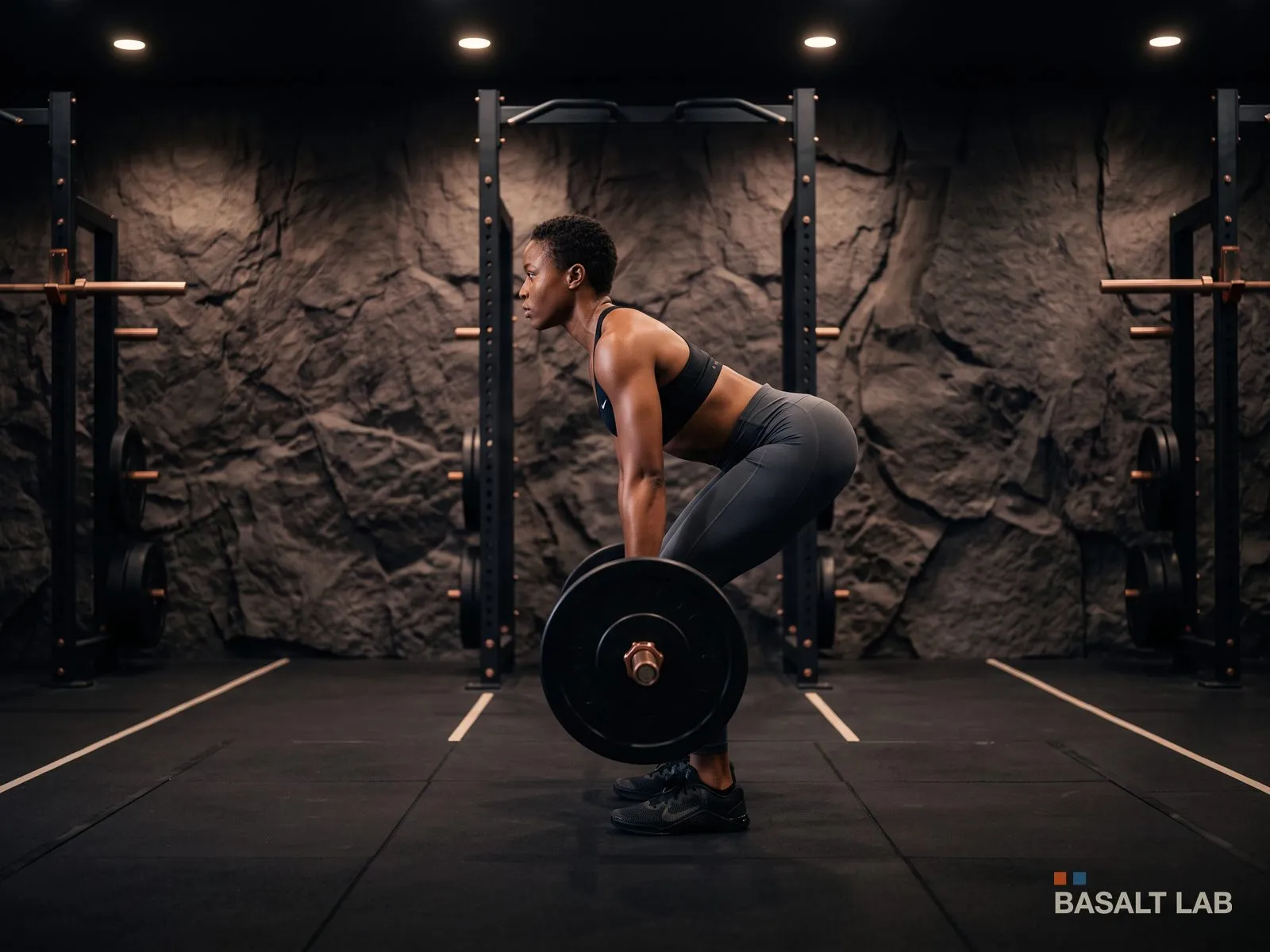
Getting into position. Bend down to grab the bar without moving it, then bring your knees forward until your shins touch it. Your hips end up higher than your knees and lower than your shoulders, shoulders slightly in front of the bar. If your shin pushes the bar forward, start again: it needs to stay over the middle of your foot.
Your back: neutral before you pull
Your back locks in before the bar leaves the floor, not during the lift. Pull the bar toward you with straight arms until you feel your upper back tighten and your lower back hold its natural curve. Only then push the floor away with your legs.
Why this is the adjustment that matters. Measurements taken on powerlifters at a national championship estimated compression on the L4/L5 vertebra at more than 17,000 newtons on the heaviest pulls. The spine handles those loads when it is stable. A review of injuries in powerlifting notes that keeping the lumbar curve and a more upright torso is considered the best protection, while pointing out that the evidence is limited: most studies are single case reports.
Lower back first. That is the part that must not round. If it gives way, it is the first sign that the load is beyond your form for the day.
Eyes. Straight ahead or slightly down, head in line with your spine. Looking up at the ceiling arches your neck and adds nothing.
The lift: push, then lock out
Think "push the floor away" rather than "pull the bar". The bar leaves the floor when your legs push, it passes your knees, then your hips drive forward to the bar and you finish standing tall, glutes squeezed.
Bar path. The bar travels up in a straight line, in contact with your legs. If it drifts away, even by a few centimetres, the lever arm on your lower back grows and the rep gets harder than it should be.
Hips and shoulders together. Off the floor, hips and shoulders rise at the same speed. If your hips shoot up on their own, you end up with straight legs and your back bent over the bar: your back finishes the job.
The top. Standing, hips and knees straight. No need to lean back: the rep is done when you are upright.
Lowering. Hips back first, bar along your thighs, then bend your knees once the bar has passed them. Set it down, reset your back, and only then start the next rep.
Breathing and bracing
Take a big breath at the top or just before you pull, fill your belly, hold it, and keep it until the bar has passed your knees. Breathe out at the top or once the bar is back on the floor.
That held breath, the Valsalva manoeuvre, raises the pressure in your abdomen and stiffens your trunk around the spine. It also raises blood pressure during the effort: if you have high blood pressure or a heart condition, ask a health professional before you train heavy. A lifting belt is not needed to learn the lift; it helps bracing on heavy sets, once you can brace well without it.
Mistakes that cost the most
| Mistake | What it costs | The fix |
|---|---|---|
| Bar too far from your shins | A longer lever arm on your lower back | Bar over the middle of your foot |
| Lower back rounding | A less solid spine under the load | Lock your back in before pulling, go lighter |
| Hips shooting up first | Your back finishes the lift instead of your legs | Hips and shoulders rise together |
| Bar drifting away from your legs | A harder rep, more load on your back | Keep the bar against your legs to the top |
| Jerking the bar off the floor | Your back moves at the heaviest moment | Take the slack out of the bar before you push |
| Leaning back at the top | Needless compression on your lower back | Stop when upright, glutes squeezed |
The most costly is the second. A lower back that rounds on the last rep of a set means the load was too heavy that day: the next set goes lighter.
Variations: sumo, Romanian, trap bar
The conventional deadlift is not mandatory. Each variation shifts the work, and you can pick the one that suits your body and your goal.
Sumo. Feet very wide, toes turned out, hands between your legs. At a national championship, sumo lifters stood about 70 cm wide against 32 cm for conventional lifters, toes turned out 42° against 14°. The torso stays more upright, the bar travels less distance and mechanical work was 25 to 40% lower. Another analysis measured a moment at L4/L5 about 10% lower than in the conventional style. Your quads do more work in the sumo.
Romanian. You start standing, lower the bar along your thighs by pushing your hips back, knees slightly bent, until you feel the back of your thighs stretch, then stand back up. A systematic review shows higher hamstring activity than lower back activity on this variation. It is the one used in the beginner full body program.
Trap bar. A hexagonal bar you stand inside. In powerlifters, it allowed heavier lifts (265 kg on average against 245 kg with a straight bar), with lower moments at the lower back and hips and higher moments at the knees. It is often the best way to learn to pull from the floor.
Adding weight to your deadlift
Work in a low rep range, for example three sets of five to eight, and add weight when every set reaches the top of the range with the same form. The step is 5 kg in total, one 2.5 kg plate on each side. The full rule is here, and the plate calculator tells you what to load on the bar.
Leave some margin. The deadlift is very tiring for a small number of sets. Stop each set with one to three reps in reserve and keep failure for other exercises. The underlying principle is progressive overload: a little more than last time, and no more.
Volume. A set of deadlifts counts for your hamstrings and glutes, and as half a set for your back. The full count helps you avoid stacking it with your squat without noticing.
Estimating your max. No need to test it. One heavy set of three to six reps is enough, and the 1RM calculator turns it into an estimate without the risk.
Frequently asked questions
Is the deadlift bad for your back?
It puts a heavy load on the spine, but the research does not show it is more dangerous than any other heavy lift, and the evidence on injuries rests mostly on single case reports. The risk comes from a load that rises faster than your form. In patients with mechanical low back pain, supervised deadlift programs have even been used in rehabilitation, with better results in those who had the least pain at the start. That does not replace a health professional’s advice if you are in pain.
What muscles does the deadlift work?
Mainly your glutes, hamstrings and spinal erectors; your quads work off the floor, and your traps and forearms hold the bar. The Romanian variation puts more emphasis on the hamstrings, the sumo on the quads.
Sumo or conventional: which should you pick?
The one where your back stays neutral most easily. Try both over a few light sessions: depending on your build and your hip mobility, one of them will suit you better. Pick one and stick with it for several months: your numbers only compare with themselves.
How often should you deadlift?
Once or twice a week is enough to progress, usually with heavy sets on one day and a lighter variation, such as the Romanian, on the other. The lift is very tiring for a few sets: a few good sets beat many average ones.
Do you need a belt?
Not to learn. A belt helps you keep pressure in your abdomen on heavy sets, but it does not replace breathing and bracing. Learn to lock your trunk without it first.
Bar over the middle of your foot, back locked before you pull, bar against your legs, and a load that goes up only when your form keeps pace.
Sources
- Lumbar spine loads during the lifting of extremely heavy weights, Cholewicki, McGill and Norman, Medicine & Science in Sports & Exercise, 1991.
- A three-dimensional biomechanical analysis of sumo and conventional style deadlifts, Escamilla et al., Medicine & Science in Sports & Exercise, 2000.
- An electromyographic analysis of sumo and conventional style deadlifts, Escamilla et al., Medicine & Science in Sports & Exercise, 2002.
- Electromyographic activity in deadlift exercise and its variants. A systematic review, Martín-Fuentes, Oliva-Lozano and Muyor, PLoS One, 2020.
- A biomechanical analysis of straight and hexagonal barbell deadlifts using submaximal loads, Swinton et al., Journal of Strength and Conditioning Research, 2011.
- Narrative review of injuries in powerlifting with special reference to their association to the squat, bench press and deadlift, Bengtsson, Berglund and Aasa, BMJ Open Sport & Exercise Medicine, 2018.
- Which Patients With Low Back Pain Benefit From Deadlift Training?, Berglund et al., Journal of Strength and Conditioning Research, 2015.
- The Valsalva maneuver: its effect on intra-abdominal pressure and safety issues during resistance exercise, Hackett and Chow, Journal of Strength and Conditioning Research, 2013.
- Application of the Repetitions in Reserve-Based Rating of Perceived Exertion Scale for Resistance Training, Helms et al., Strength and Conditioning Journal, 2016.