Strength plateau: how to break it in 4 questions
Your lifts have stopped going up for weeks? Four questions to find what is causing a strength plateau, and what to change, in order, before starting over with a new program.

When you hit a strength plateau, do not switch programs straight away. Ask four questions, in this order: is it really a plateau, are you recovering, is your volume high enough, and is your program still asking for something new? The first "no" almost always points to the cause.
A plateau is a weight or a rep count that stops moving on an exercise for several weeks, while you keep training normally. It is frustrating, and the most common reaction is also the least useful one: changing everything at once. The new program starts from zero, and you never find out what was holding you back. Progressive overload is still the principle; the diagnosis is about finding which variable stopped moving.
Question 1: is it really a plateau?
One bad session is not a plateau. It is a plateau when the trend has been flat for at least three weeks, on the same exercise, in comparable conditions. Before looking for a cause, check that the problem is real.
Look at the trend, not the last session. Sleep, stress, time of day, what you ate: a session can come out below par with nothing actually wrong. Compare four weeks, not two Tuesdays.
Compare like with like. Same exercise, same range of motion, same rest time. A shallower squat last week, or two minutes of rest instead of four, skews the comparison one way or the other.
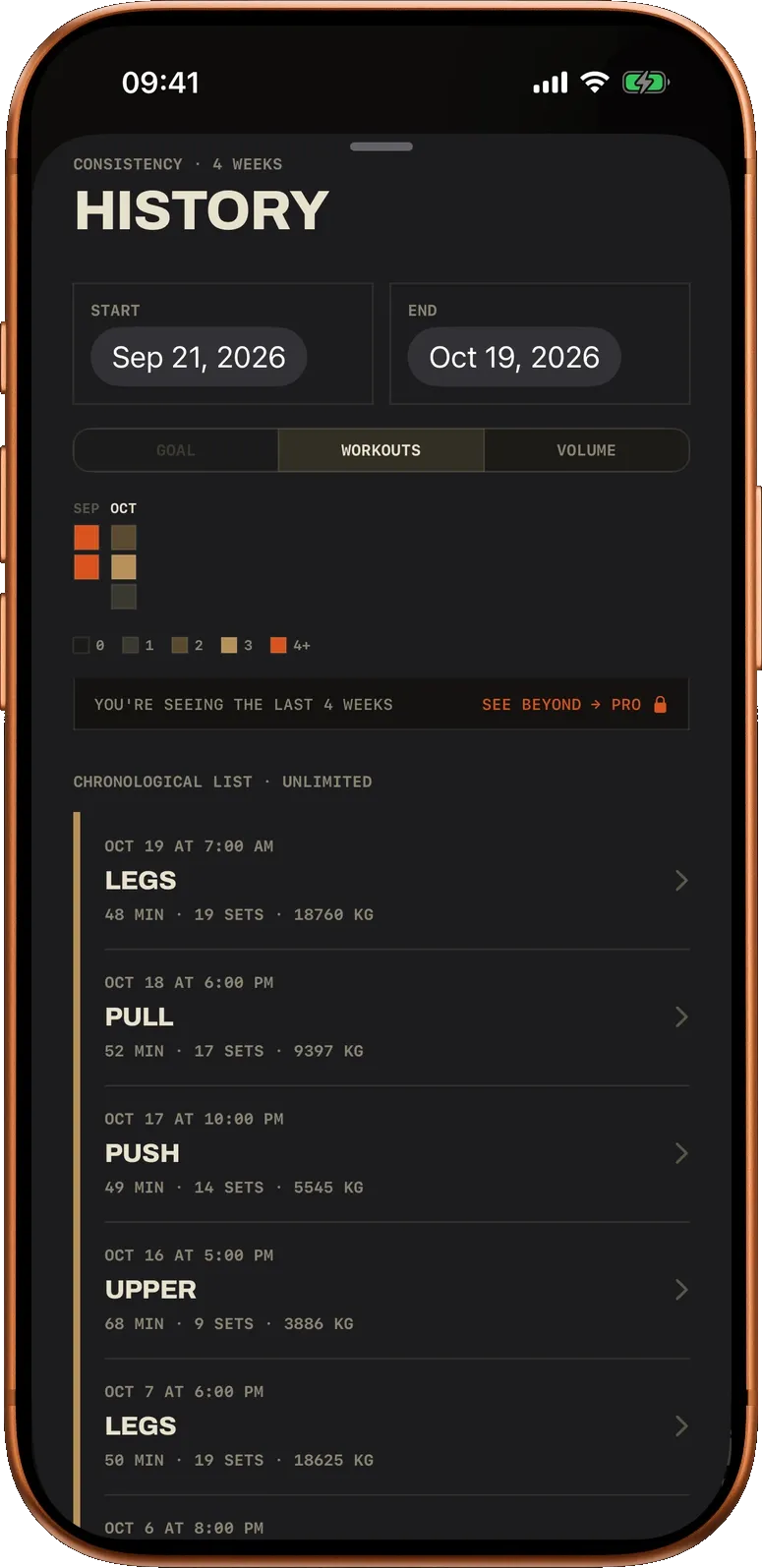
No history, no diagnosis. This is the step people skip most often. Memory keeps the good sessions and forgets the missed reps. Logging every set, with the weight and the reps you actually did, is the only way to see a stall.
Take a squat for three sets of five. At 100 kg, everything goes. The weight moves up to 102.5 kg, and the next week you miss one rep. Then two, then three. Five sessions later, you are at 102.5 kg for 4, 4, 4: that is a plateau.
Question 2: are you recovering?
Progress happens between sessions, not during them. If sleep, food or accumulated fatigue fall behind, the weight on the bar falls behind too. This is the most common cause, and the easiest one to check.
Sleep. A review of 17 studies found that several nights of short sleep in a row can reduce force output on multi-joint lifts, like the squat or the bench press, but not on single-joint exercises. A single sleepless night, on the other hand, changed little. If your plateau mostly hits the big lifts and your nights have got shorter, take that lead seriously.
Protein. A meta-analysis of 49 trials found no further gains in lean mass beyond about 1.6 g of protein per kilogram of body weight per day. It is not a hard minimum, but it is a useful order of magnitude: well below it, it may be holding you back; above it, adding more will not unlock anything.
Accumulated fatigue. Joints that stay sore, motivation that fades, weights dropping on several exercises at once: these are the signs of a deload week. In a 2024 survey of 246 strength and physique athletes, about half named stalling or dropping performance among their reasons to deload.
Question 3: is your volume in the right range?
The number of sets per muscle per week is the second lever after the weight. Too few, and the stimulus is no longer enough; far too many, and recovery cannot keep up. Count before you change anything.
A 2017 meta-analysis found a dose-response relationship between weekly volume and muscle growth: each extra set came with a slightly larger gain, and groups doing ten or more sets per muscle per week tended to grow more. That does not mean more is always better. The practical ranges are in the article on how many sets per week.
If you are below the range, add one set on the exercise that is stuck, not three across the whole session. If you are already high, adding more will not fix anything: look at recovery (question 2) or intensity instead.
Question 4: is your program still asking for something?
A program that never changes eventually stops asking for anything new. Early on, adding weight every week is enough; after a few months, you need finer rules.
The progression rule. The American College of Sports Medicine position stand recommends raising the weight by 2 to 10% once you can do one or two reps more than your target. Move up faster than that, or on the back of one good session, and the weight eventually catches up with you. The full method is in when to add weight.
Variation. For intermediate and advanced lifters, the same position stand recommends working across a wider range, from 1 to 12 rep maximum, in a periodized way. In practice: if you have been doing 3 × 5 for six months, a block of eights on the same lift can restart progress without breaking anything.
Real effort. A set stopped far from failure does not push as hard as a set with only a few reps in reserve. If every set feels easy, that may be where the stall comes from.
What to change, in order
One change at a time, and four weeks to judge it. Otherwise, you will not know what worked.
| Likely cause | What you see | First change |
|---|---|---|
| Not a real plateau | One or two sessions below par, nothing in the trend | Nothing, keep going and log everything |
| Recovery | Big lifts dropping, short nights, general fatigue | Sleep, protein, then a lighter week |
| Volume too low | Fewer than ten sets a week for the muscle involved | One more set on the stuck exercise |
| Stale program | Same rep scheme for months | A block in a different rep range |
| Not enough effort | Every set finished with plenty left | Take sets closer to failure |
Switching exercises or programs comes last. Not because it is useless, but because the counter resets and you lose the comparison.
Frequently asked questions
How long does a strength plateau last?
There is no typical length. A stall counts as a plateau after about three weeks without progress on an exercise; how long it lasts depends mostly on how fast you find the cause. A recovery plateau often lifts in a week or two, a program plateau needs a new block.
Should you change programs when you plateau?
Not first. A full change wipes out your reference points and hides the cause. Check recovery, volume and your progression rule first; if all of that is in place and the same scheme has been running for months, change the rep range, then the program if needed.
Is it normal to plateau after a year of lifting?
Yes. The fast gains of the first months slow down with experience, and the recommendations for intermediate lifters build in more variation for exactly that reason. Plateauing after a year does not mean you have hit your limit, only that the beginner method is no longer enough.
Can pain cause a plateau?
Yes, and it is a reason not to push through. A joint that complains lowers the weight you can move without you noticing. Pain that persists should be checked by a health professional before you resume progressing.
A plateau is not a wall: it is one variable that stopped moving, and four questions are usually enough to find it.
Sources
- American College of Sports Medicine position stand. Progression models in resistance training for healthy adults, American College of Sports Medicine, Medicine & Science in Sports & Exercise, 2009.
- Inadequate sleep and muscle strength: Implications for resistance training, Knowles, Drinkwater, Urwin, Lamon and Aisbett, Journal of Science and Medicine in Sport, 2018.
- A systematic review, meta-analysis and meta-regression of the effect of protein supplementation on resistance training-induced gains in muscle mass and strength in healthy adults, Morton et al., British Journal of Sports Medicine, 2018.
- Dose-response relationship between weekly resistance training volume and increases in muscle mass: A systematic review and meta-analysis, Schoenfeld, Ogborn and Krieger, Journal of Sports Sciences, 2017.
- Deloading Practices in Strength and Physique Sports: A Cross-sectional Survey, Rogerson, Nolan, Androulakis Korakakis, Immonen, Wolf and Bell, Sports Medicine - Open, 2024.