AI workout coach: how Basalt Lab revolutionizes it
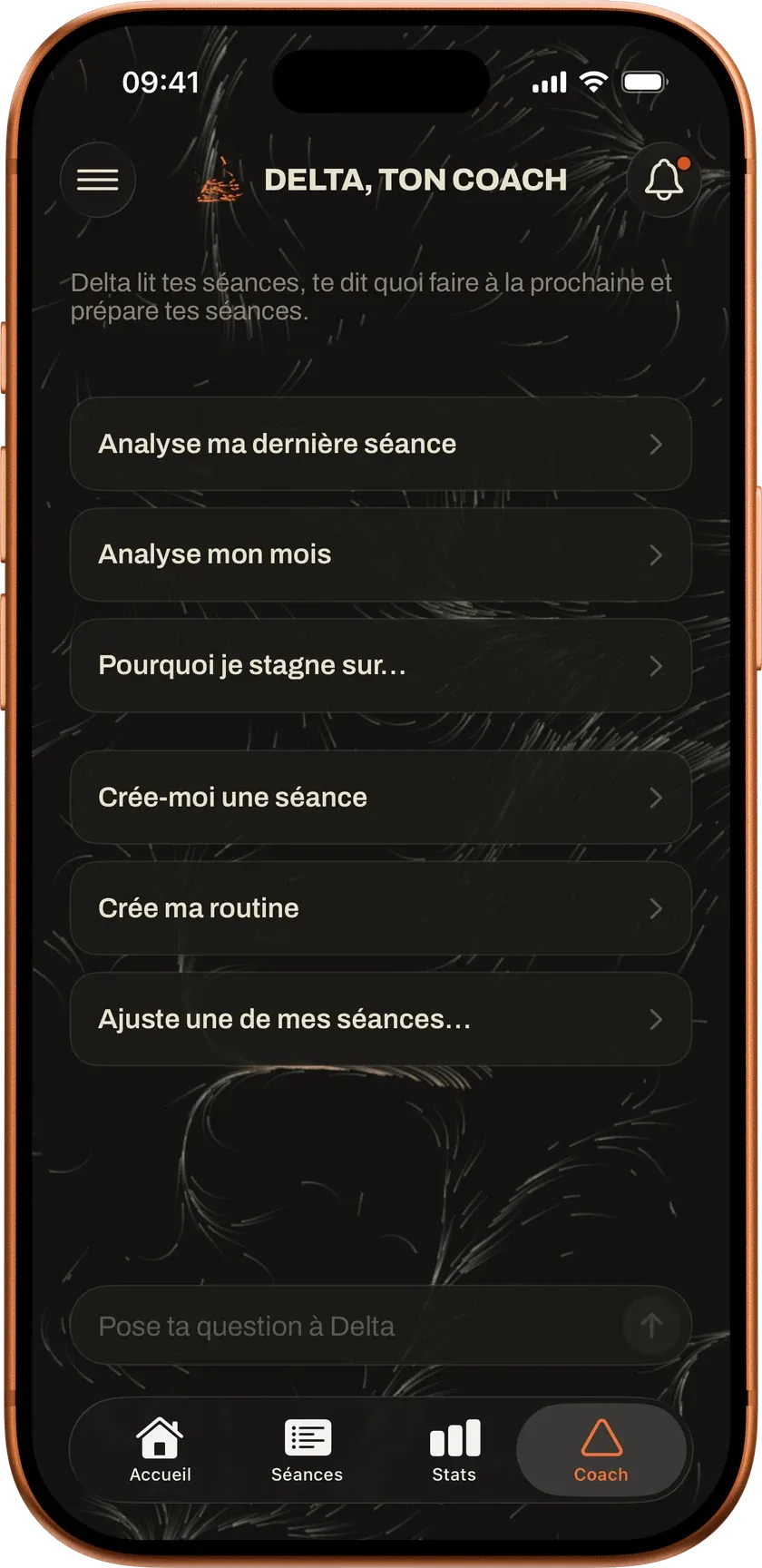
With Delta, its AI workout coach, Basalt Lab goes against general-purpose assistants: it starts from your logged sessions, holds back numbers without data and has every answer checked.
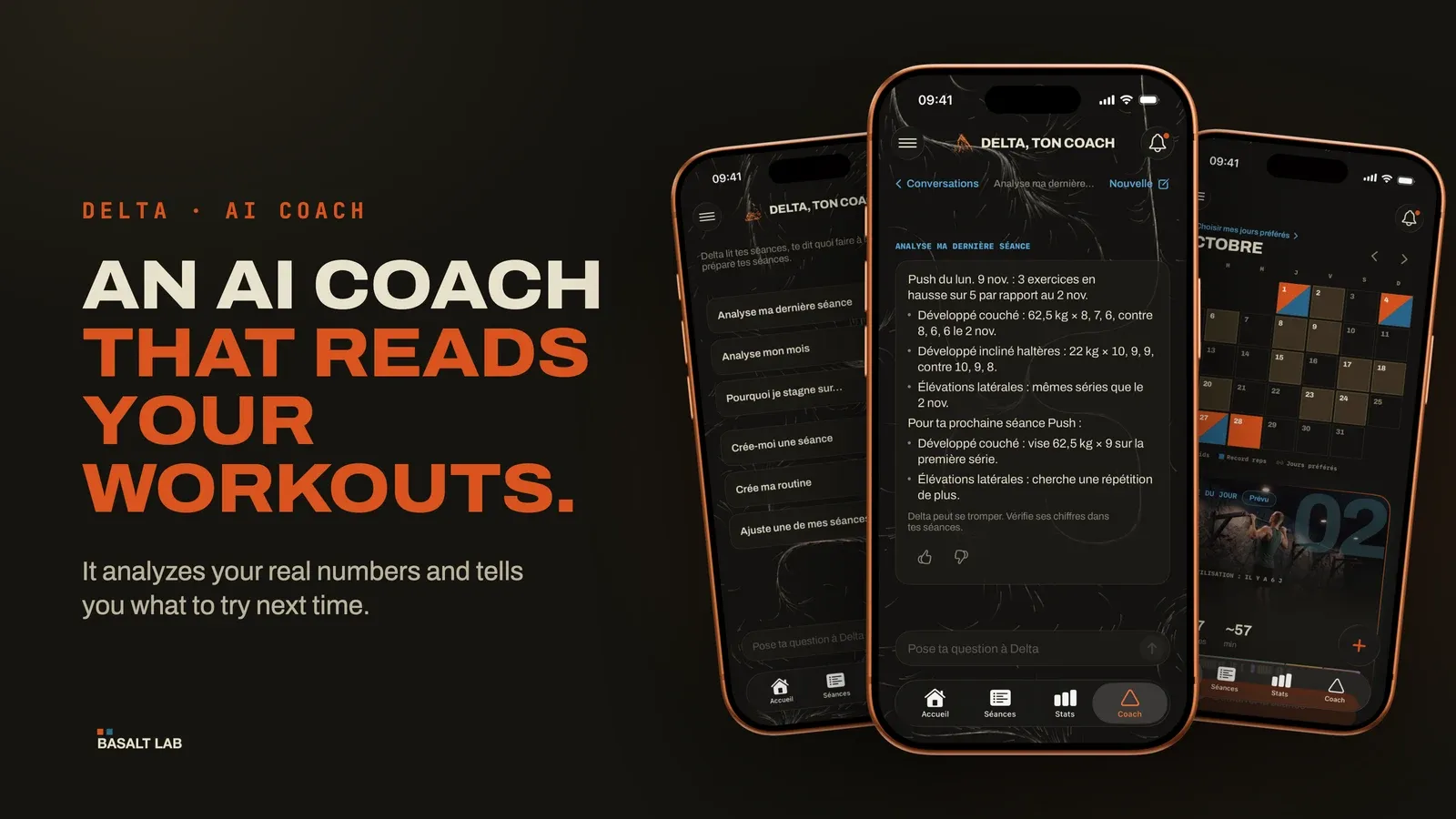
An AI coach that will not give you a number until it knows you well enough: that is the bet behind Delta, which arrived with version 2.0 of Basalt Lab. Here is what sets it apart from assistants that answer everything.
In short
- Delta does not start from a template program: it reads your last six weeks of workouts, set by set.
- It only gives a weight to aim for on an exercise you have done at least three times in that period.
- Every answer is checked by a program before it is shown, and nothing changes in the app without your say.
Ask ChatGPT or another general-purpose assistant for a workout plan, and you will have an answer in ten seconds. It will be clean, well laid out, and identical to the one your neighbor gets: the assistant knows nothing about what you lifted last week. With Delta, released on 17 November 2026 in its workout tracker app for iPhone and Apple Watch, Basalt Lab comes at the problem from the other side. This coach, built on artificial intelligence, only talks about what it has read in your workout log.
Also read: Strength plateau: how to break it in 4 questions
Unlike ChatGPT, the Delta AI coach reads your real workouts
It all comes down to the raw material. With every request, Delta receives your last six weeks of training in detail: exercises, sets, weights, reps and how each set felt. It adds your saved sessions and your answers from the welcome questionnaire, such as your goal or your equipment.
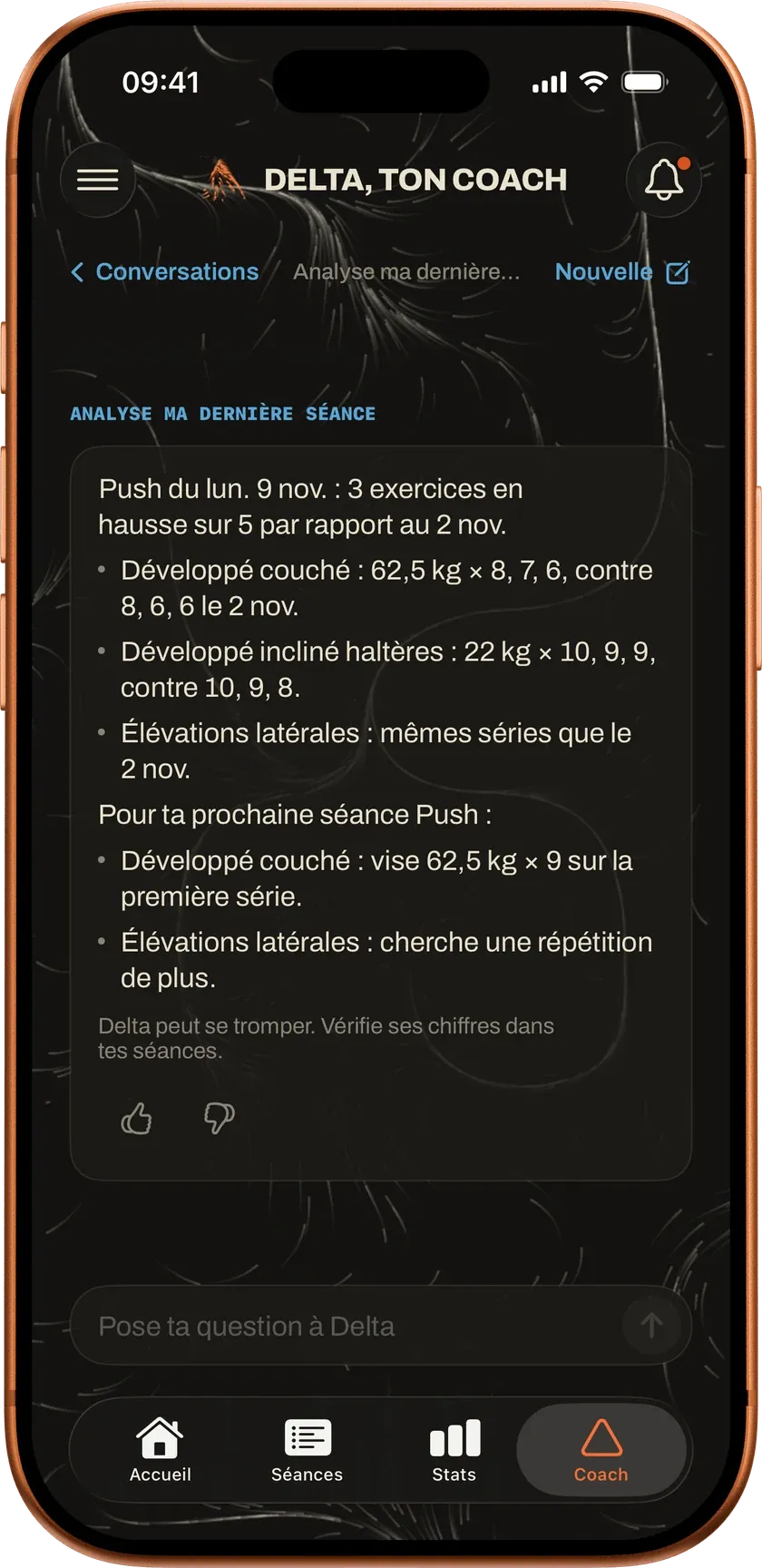
The result shows from the first analysis. Where a general-purpose assistant would tell you your workout was “solid”, Delta compares each exercise with the previous time, date included. Its internal brief puts it bluntly: “Without these comparisons, the person learns nothing they do not already know.”
Delta gives you no number until it knows you well enough
Delta only gives a weight or a rep count to aim for on an exercise you have done at least three times in the last six weeks. Below that, it sticks to a direction, such as “go for one more rep”, even if you push for more.
When it does give a number, a ceiling applies: one more rep than your best set, or the smallest weight jump. After 10 reps, it writes “aim for 11”, never “aim for 10 to 12”. That is cautious, and it is also how people actually progress. We explain it in our guide on when to add weight.
Every answer from Delta is checked before you read it
Generative AI sometimes makes things up with total confidence, and Delta was no exception. During testing, it praised the consistency of an account that was far below its training goal. Basalt Lab turned that into a safeguard: a program now reads every answer before it is shown. If a number it quotes does not exist in your workouts, the answer is requested again.
The app does not claim to be infallible either. The same line sits under every answer: “Delta can be wrong. Check its numbers against your workouts.”
The Delta AI coach suggests and all you have to do is decide
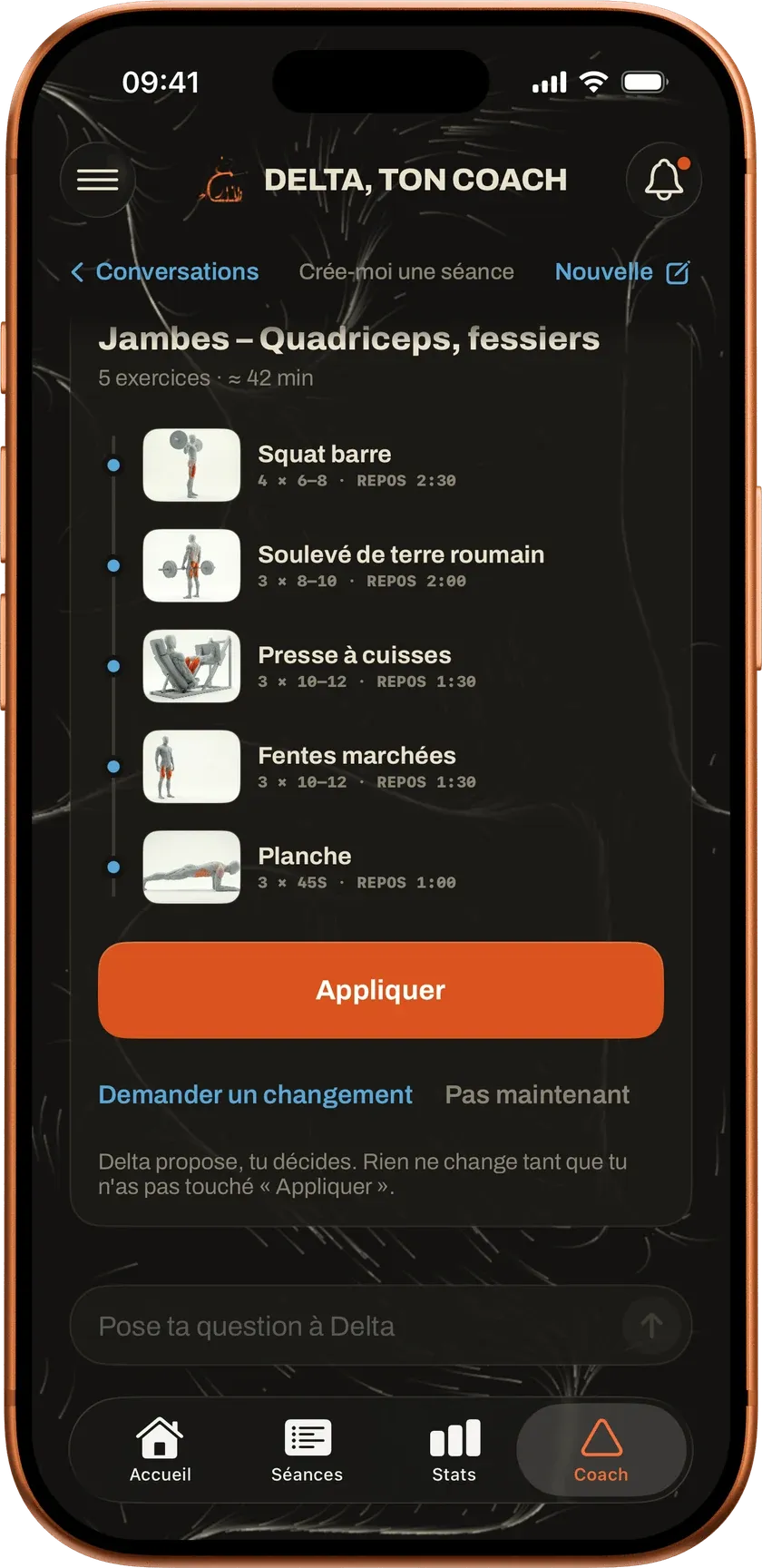
Delta changes nothing in the app on its own. When it creates or adjusts a session, it shows a card and waits for you to tap Apply.
The same restraint applies to privacy. Delta stays off until you have given your consent. Each request is then processed by Claude, Anthropic’s AI, in the United States, without your name, your email, your body weight or your Apple Health data, unless you type them into your question yourself.
Anthropic does not use this data to train its models and deletes it within 30 days, unless the law requires otherwise or the content is flagged as violating its usage policies (up to 2 years). The privacy policy and the answer to “What does Delta see of my data?” on the Support page, both updated on 15 November 2026 for version 2.0.0, explain these rules in detail.
Finally, Delta is not a health professional: if you mention pain, it makes no diagnosis and advises you to talk to one.
Frequently asked questions
Is the Delta AI coach free?
No. Delta is part of Basalt Lab Pro. Pro also includes Lab mode, your previous session replayed set by set and 33 advanced statistics.
Can you ask ChatGPT for a workout plan?
Yes, and it will write a decent one. But it does not know your workouts unless you paste them in every time, and nothing checks the numbers it puts forward. Delta reads your log directly, and its answers are checked before they are shown.
Does the Delta AI coach work on Apple Watch?
No. You use Delta on iPhone, in the Coach tab. The watch is for logging your sets during the workout, and those are the sets Delta analyzes afterwards.
Sources
- How long do you store my organization’s data?, Anthropic Privacy Center.
- Is my data used for model training?, Anthropic Privacy Center.