Volume load: how to calculate it and how to read it
Volume load = weight × reps, added up over your working sets. A worked example, how to read your trend week after week, and its limits according to two studies.
Volume load is the total weight you lift in a workout: the weight multiplied by the reps, set by set. Here is how to calculate it in a minute, and what you need to know to read it well.
In short
- 3 sets of 10 at 60 kg = 1,800 kg. That is the whole calculation.
- 4 sets of 10 at 105 kg = 4,200 kg. 11 sets of 3 at 126 kg = 4,158 kg. For someone who squats 140 kg, these two workouts give almost the same volume load, yet one is made of long sets and the other of heavy sets.
- Same volume load, half the muscle growth with very light loads. In a 12-week study, a thigh muscle grew 8.9% with loads at 20% of max, against 19.5% at 80%.
Volume load, also called tonnage or training volume, helps you track progress from one week to the next and chart your volume over time. You still need to calculate it the same way every time, and to know what it does not show.
Also read: Progressive overload: the one principle behind progress
To calculate your volume load, multiply the weight by the reps
An example from a three-exercise workout:
| Exercise | Sets | Volume load |
|---|---|---|
| Squat | 3 × 5 at 100 kg | 1,500 kg |
| Bench press | 3 × 8 at 70 kg | 1,680 kg |
| Barbell row | 3 × 10 at 60 kg | 1,800 kg |
| Workout total | 9 sets | 4,980 kg |
Three rules to keep the number accurate:
- Leave warm-up sets out. Only working sets go into the total.
- Count the reps you actually did. A set planned for 8 that stops at 7 counts as 7.
- For bodyweight exercises, pick a rule and keep it. Add your body weight for pull-ups and dips, or leave them out of the total, but always do the same.
To read your volume trend, compare a workout with the same workout
Volume load depends on the exercises: a squat moves far more kilograms than a curl. So compare your leg day with last week's leg day, never with your arm day. On the same workout, here is how to read your volume load:
- It rises slowly: you are doing more reps or lifting heavier. You are progressing.
- It jumps suddenly and fatigue follows: a deload week can help.
- It has not moved for three weeks on an exercise: that is a sign of a plateau.
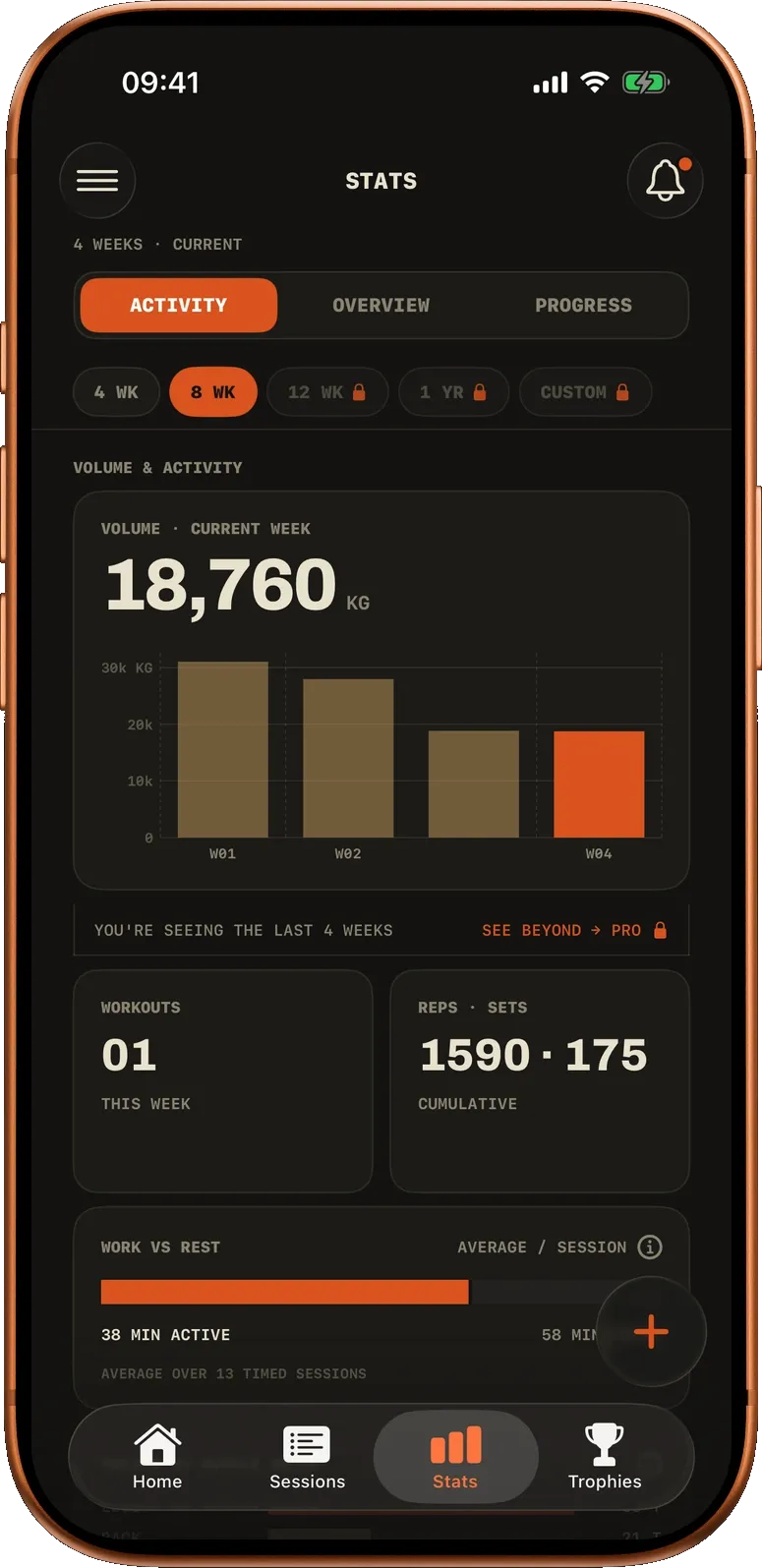
These sums are easy to do in a notebook or a spreadsheet. If you log your workouts in Basalt Lab, the app does them for you: the Stats screen shows the week's "Volume", and the history shows each workout's total. With Pro, an alert tells you when your volume runs past your average.
Two workouts with the same volume load can be very different
A 2009 study (McBride et al.) compared several ways to squat. Here are two of its protocols, with the loads calculated for someone whose squat max is 140 kg:
| What changes | Workout A | Workout B |
|---|---|---|
| Sets | 4 × 10 reps | 11 × 3 reps |
| Load | 105 kg (75% of max) | 126 kg (90% of max) |
| Rest | 90 seconds | 5 minutes |
| Estimated duration | about ten minutes | close to an hour |
| Volume load | 4,200 kg | 4,158 kg |
The volume load is almost the same, but the training is not: long sets on one side, heavy sets on the other. The total does not tell you what load you trained with. To compare two workouts, also look at the weight and reps of each set.
With the same volume load, loads that are too light build less muscle
In a 2018 study (Lasevicius et al.), 30 men trained for 12 weeks: one arm and one leg at 20% of their max, the other arm and the other leg at 40, 60 or 80%. The volume load was the same on both sides.
A high volume load is not enough on its own: each set also has to be a real effort.
For muscle growth, count your hard sets instead. A review of 14 studies (Baz-Valle et al., 2021) finds that count suitable for measuring volume, when sets fall between 6 and 20 or more reps. To know how many to do, read how many sets per muscle per week.
Frequently asked questions
How do you calculate volume load?
Multiply the weight by the reps for each working set, then add up every set. Three sets of 8 at 70 kg make 1,680 kg.
Do warm-up sets count in volume load?
No. Count only working sets, always the same way from one workout to the next.
Volume vs load for hypertrophy: which matters more?
You need both. In the study above, the same volume load lifted at 20% of max built less muscle than at 40 to 80%. Count your hard sets per muscle, and keep each set demanding.
Sources
- Effects of different intensities of resistance training with equated volume load on muscle strength and hypertrophy, Lasevicius T, Ugrinowitsch C, Schoenfeld BJ et al., European Journal of Sport Science, 2018.
- Comparison of methods to quantify volume during resistance exercise, McBride JM, McCaulley GO, Cormie P et al., Journal of Strength and Conditioning Research, 2009.
- Total Number of Sets as a Training Volume Quantification Method for Muscle Hypertrophy: A Systematic Review, Baz-Valle E, Fontes-Villalba M, Santos-Concejero J, Journal of Strength and Conditioning Research, 2021.